



Business/Technology Reporter

Artificial intelligence jobs are coming our way, and they’re not just relegated to tech roles like AI engineers or available to those with deep computer-science backgrounds.
Diving into job openings, Lightcast, a labor market research firm, found that 51% of job listings last year required AI skills that were outside traditional IT and computer-science roles. Five years ago, it was 39%, according to a new Lightcast report.
“We’re finding them across marketing, across science, engineering, education, health care and across the labor market,” said Elena Magrini, head of global research at Lightcast. “They’re growing everywhere.”
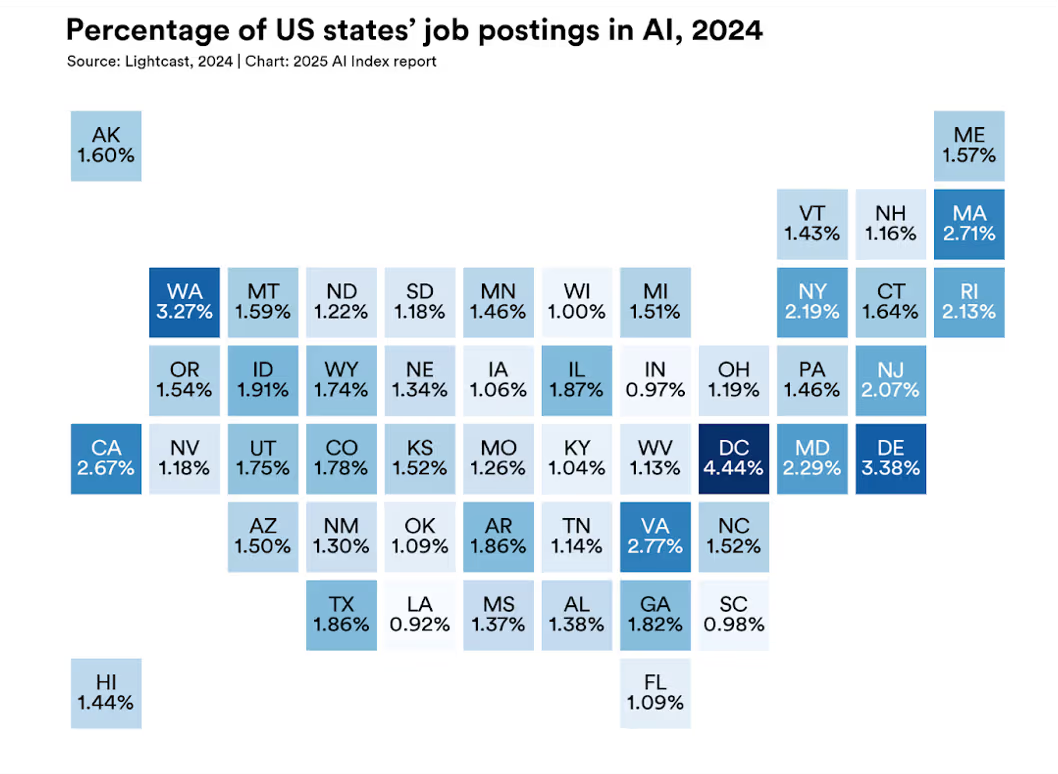
Overall, Colorado had the 16th highest rate of AI-related job openings nationwide, according to the Stanford AI Index from Stanford University and Lightcast. It’s a small fraction of overall job listings, at 1.78% in Colorado. Washington, D.C. had the highest rate, at 4.44%.
And the number is growing, according to a quarterly report from Aspen Tech and the Colorado Chamber Foundation. The number of AI-specific job postings in Colorado grew 66.5% in July from a year ago. It’s still a small number, though, at 263 jobs this month, compared to 158 a year ago.

Magrini shared a chart showing how jobs with AI skills in a variety of industries have increased since 2019. Back then, 2.27% of jobs in marketing and public relations mentioned some sort of AI skill. Last year, it was 13%. AI mentions in performing arts roles tripled to 1.55% of listings last year. That’s still a tiny fraction of jobs, but that’s a high growth rate.
“But the key message that we are trying to get across is that we need everybody to start thinking about AI and AI skills,” Magrini said. “They’re becoming a new integral part of the labor market (similar to) emails that became something that everybody started to use 20 years ago.”
Employers want it
A quick glance at some Colorado job openings includes a marketing and communications specialist for a Greenwood Village firm that is “comfortable using AI tools like ChatGPT to support content creation.” Another firm is seeking a teacher “to teach AI chatbots.” A Louisville company needs a publishing coordinator with “Proficiency in using AI tools for content creation.”
Whether they know what they’re asking for or not, employers are the ones mentioning AI, and Bjial Shah, CEO of Denver-based tech education company Guild, said that’s influenced how Guild operates.

Guild, which works with Fortune 500 companies to provide education as an employee perk, is using Lightcast’s taxonomy of 300 AI skills to make sure Guild’s “2,000+ programs teaches capabilities that employers actually demand,” according to a case study.
“I commend a lot of our employer partners because they are pretty agnostic to who’s learning and utilizing and embracing training around this technology,” Shah said. “I haven’t seen in a really long time in our country where someone we’re teaching a new technology at this pace and the employers are kind of leading that movement, which I think is pretty cool.”
Guild offers AI training to its staff, which now numbers 900, and Shah estimates that about 80% of staff is always getting trained or retrained in the AI skills helpful to their current roles.
“I think it’s true for every business,” she added. “And it’s great for our business and good for our employees to learn how to utilize AI, both generative AI and agentic AI. It’s irrelevant that you’re not in a technical part of our organization.”
In many cases, employers hiring for nontech roles are interested in job candidates who are familiar with generative AI programs like OpenAI’s ChatGPT or Anthropic’s Claude because there’s a sense that the individual is interested in learning something new, even if it just ends up just being another skill workers can add to their resumes, like expertise in Excel spreadsheets or knowing a foreign language.
That familiarity will help workers with future low-tech technologies that are being tested and adopted at companies all over.
Denver-based startup Pico AI is developing an AI-based tool to help the building and facilities industries manage operations. It’s more of an assistant that you tell what the problem is and it’ll help you figure out solutions or put a support ticket together, founder Jesus Salazar said.
“Instead of filling out a ticket, the person that identified the issue just talks to it like a hallway conversation,” Salazar explained. “The drain is backed up in the lobby here and the AI then knows instantly what questions to ask (and) creates a ticket to send to the building engineer.”
That frees up the employee’s time who would otherwise be trying to track down relevant information. And the employer can make business decisions based on the increased efficiency, whether that’s reducing workforce or expanding a worker’s role. Humans are still needed but in different capacities.
“Individuals are now going to have the skills of mini managers,” Salazar said. “It’s like you’ve got all these really great interns. They’ve got so much promise (but) require direction.”
➔ Trump administration unveils AI plan. It aims to remove “onerous regulation,” and ban AI-related federal funding to “states with burdensome AI regulations that waste these funds but should also not interfere with states’ rights to pass prudent laws that are not unduly restrictive to innovation.” Colorado’s controversial AI law, which was intended to protect consumers from possible harms of artificial intelligence, may be a target. Senate Bill 318 goes into effect Feb. 1, after an attempt to change it failed in May. >> Read America’s AI Action Plan
Reader poll: AI at work and play

Does your job require experience with new AI tools? Do you wish it didn’t? Take the current reader poll to help report on what’s happening in Colorado.
➔ Take the poll: cosun.co/WW-AIjobs
Sun economy stories you may have missed

➔ Starlink, Amazon ask for $300M of Colorado’s broadband money after federal rule changes. Colorado had to redo its grant program after the Trump administration changed the rules to prioritize the cheapest proposals. Fiber took a back seat. >> Read story
➔ Colorado could reap millions of federal grant dollars previously withheld by Trump. The money is part of a pot of more than $5 billion that covers a variety of grant programs >> Read story
➔ Building new gas power plants would mean higher energy bills. Here’s how the math works >> Read story

➔ First responders in Colorado’s mountain towns are receiving wave of unfounded texts for help from satellite-enabled iPhones. At least 10 Colorado 911 dispatch centers have received emergency texts from iPhones saying people were trapped, lost or on fire >> Read story
➔ The number of people starting a Colorado business jumped 19% from a year ago. That was a surprise increase and could be a sign some residents are confident about their startup prospects or need an additional income, state officials say >> Read story
➔ Trump’s cuts to public broadcasting leave 52 local Colorado stations staring at massive budget holes. With listeners in every Colorado congressional district, many in rural areas, the radio stations are funded in large part by the Corporation for Public Broadcasting >> Read story
Vetted local news is worth supporting Become a member!
Other working bits
➔ Business fraud complaints in Colorado doubled in June. Last month, the Secretary of State’s Office received 284 complaints about business fraud, up 123.6% from a year ago June, according to the Colorado Secretary of State’s Office. Complaints either were new businesses that used someone else’s name or address without their consent or the existing business record changed without proper authority. Since February 2023, 4,700 similar complaints were filed and 3,000 were resolved. >> Suspect fraud? File a complaint
➔ Metro Denver rents fall 3.7% from last year. The average rent dropped to $1,832 a month in the second quarter, compared with $1,903 a year ago, according to the latest report from Apartment Association of Metro Denver. That’s a few dollars more than $1,819 in the first quarter. Cary Bruteig, who authored the report, attributed the decline to new apartments coming online and elevated vacancy rates of 6.4%, which was higher than a year ago though lower than first quarter’s 7%. >> Data
➔ 127,600 job openings in Colorado, as of July 1. That’s according to Aspen Tech Labs, which tracks online job listings on behalf of the Colorado Chamber Foundation. Openings were flat, up 0.7% from April. But it bested the nation, which had a decline of 2.8%. With the state’s high-ish unemployment rate, which fell a tenth of a point to 4.7% in June, it “elevates the importance of the Chamber Foundation’s work to close the workforce talent gap statewide,” Rachel Beck, the Foundation’s executive director, said in a news release. Some of the chamber’s work included participation in workforce summits around the state. >> View report
Got some economic news or business bits Coloradans should know? Tell us: cosun.co/heyww
Thanks for sticking with me for this week’s report. As always, share your 2 cents on how the economy is keeping you down or helping you up at cosun.co/heyww. ~ tamara
Miss a column? Catch up:
What’s Working is a Colorado Sun column about surviving in today’s economy. Email tamara@coloradosun.com with stories, tips or questions. Read the archive, ask a question at cosun.co/heyww and don’t miss the next one by signing up at coloradosun.com/getww.
Support this free newsletter and become a Colorado Sun member: coloradosun.com/join

The Colorado Sun is part of The Trust Project. Read our policies.
Corrections & Clarifications
Notice something wrong? The Colorado Sun has an ethical responsibility to fix all factual errors. Request a correction by emailing corrections@coloradosun.com.