
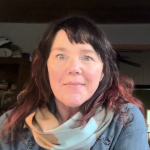

Erin Karney Spaur’s family wouldn’t have the ranch they do today if it weren’t for the ornate box turtle that plods across the sandy soils of eastern Colorado.
Karney Spaur is a seventh-generation Coloradan whose dad’s family arrived in Higbee 15 years before Colorado became a state in 1876. But for various reasons, neither of her parents’ families were able to pass a ranch between generations. Her parents finally caught their opportunity to buy a 17,000-acre place to raise cattle near Las Animas in 2001. Then came the worst drought in decades, forcing them to sell off half of their herd. By 2002, the bank was calling. They were on the brink of losing another property.
“But here’s the funny part,” said Karney Spaur, from her seat behind a giant desk in the newly renovated, historic Livestock Exchange Building at the National Western Complex during the National Western Stock Show in Denver last week.
She explained that the Colorado Department of Transportation needed to mitigate a highway project through critical box turtle habitat. The Nature Conservancy was looking for a rancher to protect box turtles with a conservation easement. Karney Spaur’s mom saw an ad in the local paper. And the one-time payment CDOT made them saved the ranch.
That’s a story about ranchers working with industry and conservation to come to three happy endings. But it’s also a key piece of the story of Karney Spaur, who, at 35, is the first woman executive vice president of the 158-year-old Colorado Cattlemen’s Association at a time of great disruption across the agriculture industry.

“Growing up on a cattle operation allows Erin to understand what we are all dealing with from droughts, to wolves, to what could happen with disease like screwworm and more,” said Tim Ritschard, a Grand County rancher and president of the Middle Park Stockgrowers Association.
Other issues include private property rights, local control, grazing access, soil health and arguably “more challenges than producers in Colorado have ever faced to keep agriculture and animal agriculture a vibrant, sustainable part of our rural landscapes and communities,” said Ginny Harrington, an Eagle County rancher and membership chair of the Holy Cross Cattlemen’s Association.
“But Erin’s lifelong dedication to CCA and the Beef Industry puts her head and shoulders above the typical executive of a trade organization,” Curt Russell, a Sugar City rancher and current president of the Colorado Cattlemen’s Association, wrote in an email.
And it’s time to give her and other women agriculture industry leaders their due during this United Nations-declared International Year of the Woman Farmer, said Robert Sakata, a Brighton-area farmer and first-ever agricultural water policy advisor for the Colorado Department of Agriculture.
A born bridge-builder
Not every kid wants to wake up at the crack of dawn to trudge into the freezing cold to milk cows or collect eggs — but Karney Spaur and her brother did.
They were key to helping their parents keep the ranch near Las Animas going in the early days.
“But what’s crazy is my dad got a second job while my mom ran the ranch,” when it’s typically the other way around, Karney Spaur said. And it was her mom who jumped on the idea to do a conservation easement. So Karney Spaur had strong female mentorship from the beginning.
During college she was a livestock business management major in the animal sciences department at Colorado State University. She joined the meat judging team and the seed stock merchandising team, both of which brought her to competitions at the National Western Stock Show. She stayed at CSU to earn a master’s degree in meat science, which is “studying the quality and all the factors that make your steak a great steak,” she said, “and also food safety and meat safety.”
Her first industry job was at a meat processing plant in Washington, where she stayed for two years before returning to Colorado after nabbing the job of director of industry programs at Colorado Cattlemen’s Association in 2015.
Colorado has 66.3 million acres within its borders, half of which is in ranches and farms, according to the Colorado Department of Agriculture’s 2023-24 performance plan. Cattle production is Colorado’s number one agricultural commodity with 2.7 million head of cattle being raised by families in every county. And approximately 60% of the state’s $7.1 billion in agricultural cash receipts are attributed to livestock, the agency says.
Sarah Dideriksen, who now directs industry programs for the cattlemen’s association, says there are around 6,000 members spread across all of Colorado’s 64 counties. All of the current 15 members of board of directors are men. And relatively few women have served on the board, including Janie VanWinkle, who was elected 115th president in 2020.

But in 1941, wives of cattlemen formed the Colorado Stockwomen, which became the Colorado Cowbelles and is now Colorado Cattlewomen. They have an all-women board and say over the past 40 years, women have shifted from supportive roles to active management, with female ranch ownership rising from 5% to 30%.
The staff of the Colorado Cattlemen’s Association are currently women, and, like the cattlemen’s board, they’re “constantly focusing on a lot of broad-brush issues” all falling under the general umbrella of “keeping working lands in working hands,” Dideriksen said.
That includes local control and pesticide use, “because some ranches cross county lines and if a certain county wants to enforce pesticide controls and another doesn’t, there are concerns about viability if you can’t spray your whole field,” she said.
The current legislative session “will bring new challenges, too, but water is always top of mind, and private property rights are always top of mind, and the right-to-farm overarching idea,” she said.
Yet it currently seems that as soon as ranchers catch their breath, they’re caught off guard with another issue, Dideriksen said. “Like we finally felt, in late 2024, that things were slowing down for folks, and then, boom, here’s the British Columbia wolves. Then ranchers felt they were kind of getting on the same path when it came to the right (of the public) to float their waterways,” as well. But user groups have revived the fight for stream access legislation that will open public access through private property.
Ranchers have plenty of detractors, like wildlife and environmental activist Rainer Gerbach, who repeatedly calls them out for continuing to receive public subsidies — “what many call ‘welfare ranching,’” he says — while demanding lethal control of native predators and native fauna essential to ecosystem recovery.
Indeed, in 2024-25, ranchers paid the government just $1.35 per month per cow-calf pair to graze on U.S. Forest Service or Bureau of Land Management land, and in 2025, they submitted compensation claims to Colorado for livestock killed by wolves that exceeded $1 million.
Other critics judge ranchers for their “sense of entitlement to public lands.”
And animal agriculture is often under the gun for its contributions to climate change, with critics saying even regenerative grazing, hyped as a solution to locking carbon dioxide from the atmosphere in organic soil, has serious limitations.

“So I think it’s just this constant negative drum beat that feels like, as soon as ranchers are catching a breath, there’s another issue coming,” Dideriksen said. “And it’s not always the same groups, so then I think ranchers can have an even greater protectionist mindset.”
But Sakata calls Karney Spaur, who started as executive vice president in 2022, “a great problem-solver and a great listener” who can bring disparate groups together by encouraging them to consider all perspectives.
Russell says Karney Spaur learned her new role “in a bit of baptism by fire” because CCA’s former executive VP Terry Fankhauser rushed to train her through his declining health “and ultimate death” in 2024. But she has gained the appreciation of the entire cattlemen’s board and membership as she has guided them “through difficult political waters.”
Nicole Rosmarino, director of the Colorado State Land Board, says Karney Spaur “is a thoughtful and effective leader with whom I share an affinity for the grasslands of eastern Colorado, and the people who steward them. I value the open and constructive line of communication we share, and her consistent effort to build bridges across perspectives.”
Moving fast and bridging gaps
Behind closed doors, however, it’s not all clanging cymbals and blue ribbons.
Karney Spaur says she’s hearing of agriculture families struggling both from being “land rich and cash poor” and because “so many hard things they’re dealing with are stacking up.”
“So what we’re seeing a lot of is generational families calling it quits, or they’re leaving, and my fear is what’s going to happen to their land? What’s going to happen to that younger generation, if there is a younger generation? And how are we going to give opportunities to that younger generation?”
What she wishes the general public could understand is the critical role ranchlands play in creating open space, wildlife habitat and viewscapes. She thinks what people don’t realize when they see a beautiful vista or a herd of elk is that private land created the view and a safe haven for the ungulates. And with a recent USDA study showing Colorado has lost more farmland than any other state in the country in recent years, including 1.6 million acres, or 2,500 square miles, between 2017 and 2022, industry leaders say preserving open space is more important than ever.

Karney Spaur supporters say she is moving fast, literally and figuratively, to close this understanding gap.
After growing up on a ranch, she now helps her husband on his family farm in northern Colorado near Johnstown. She laughs about it, saying her family always said they’re “really bad farmers but good ranchers, and it’s really weird that I married a farmer,” but she’s grateful because she’s getting to learn the stresses and struggles her husband’s family deals with firsthand.
She also shows up to commission meetings and legislative hearings, facilitates working groups, engages with local cattlemen’s and livestock organizations and was instrumental in moving the organization’s headquarters back into its original location, the Livestock Exchange Building at the National Western Complex, 25 years after the stockyards closed in 1991.
But don’t expect to find her there if you show up unannounced.
Ritschard says one of his favorite stories about Karney Spaur was “when I called to give her an update on what was happening in Grand County and she sounded out of breath. I said, ‘What is going on?’ and she said, ‘I’m running late to go testify at the state Capitol.’”