



Reporter

Quick links: Geothermal programs in Colorado | Labor Day history | Quantum COmmons opens | Colorado unveils new job board
Matt Cooper was deep into his career as a coal miner in northwestern Colorado when an epiphany came to him like smoke from the stack.
“We’d been an energy family for a long time,” he said. “My dad worked on the oil rigs and I went into the coal industry, which was a little more stable. But they started shutting down the coal mines and the power plant up here, so I started looking for what’s next.”
It was time to make a shift.
“We” included Cooper’s wife, Kristine, his daughter, Anna, and his two sons, Matthew and Nathan. Anna lived in Craig with one of Matt’s grandchildren, while one of the sons worked at the Trapper Mine in Craig and the other at the Colowyo Mine in Meeker.
In 2023, roughly one-third of states still relied on coal as their primary energy source, but Colorado had taken the initiative to address emissions from the power sector, and was working with utilities to shutter its remaining coal plants and transition to renewable energy.
By then, one coal-fired unit had closed in Pueblo and one in Colorado Springs. Several others had closing dates between 2025 and 2031. And Craig and Hayden expected to be hard hit with three units closing in Hayden by 2028 and three in Craig by 2030.
To help families like the Coopers adjust, Colorado created the Office of Just Transition to assist communities in “retaining and developing family-sustaining jobs” and to help workers make the leap from coal to green energy, relocate or retire while “maintaining their economic security.”
Epiphany begets action
In early 2024, Cooper and his family started to get serious about their move out of the fossil fuel industry. “And what we settled on was geothermal,” he said, as “there seemed to be a need for drillers who would put in the (ground) loops.”
These are plastic pipes shaped into a “U” through which water circulates down to 1,500 feet below the Earth’s surface where “there’s a really, really beautiful temperature gradient from about 55 to 65 degrees and in some places 75 to 80,” said Joselyn Lai, CEO of Bedrock Energy, which is working in Hayden on a large-scale geothermal project.
That heat, transferred through water injected into the closed-loop, recirculating system, is also consistent no matter what the temperature is outside. So it can provide heating and cooling for a home or building, and be scaled for larger use, like an entire business development, which we’ll get to in a second.
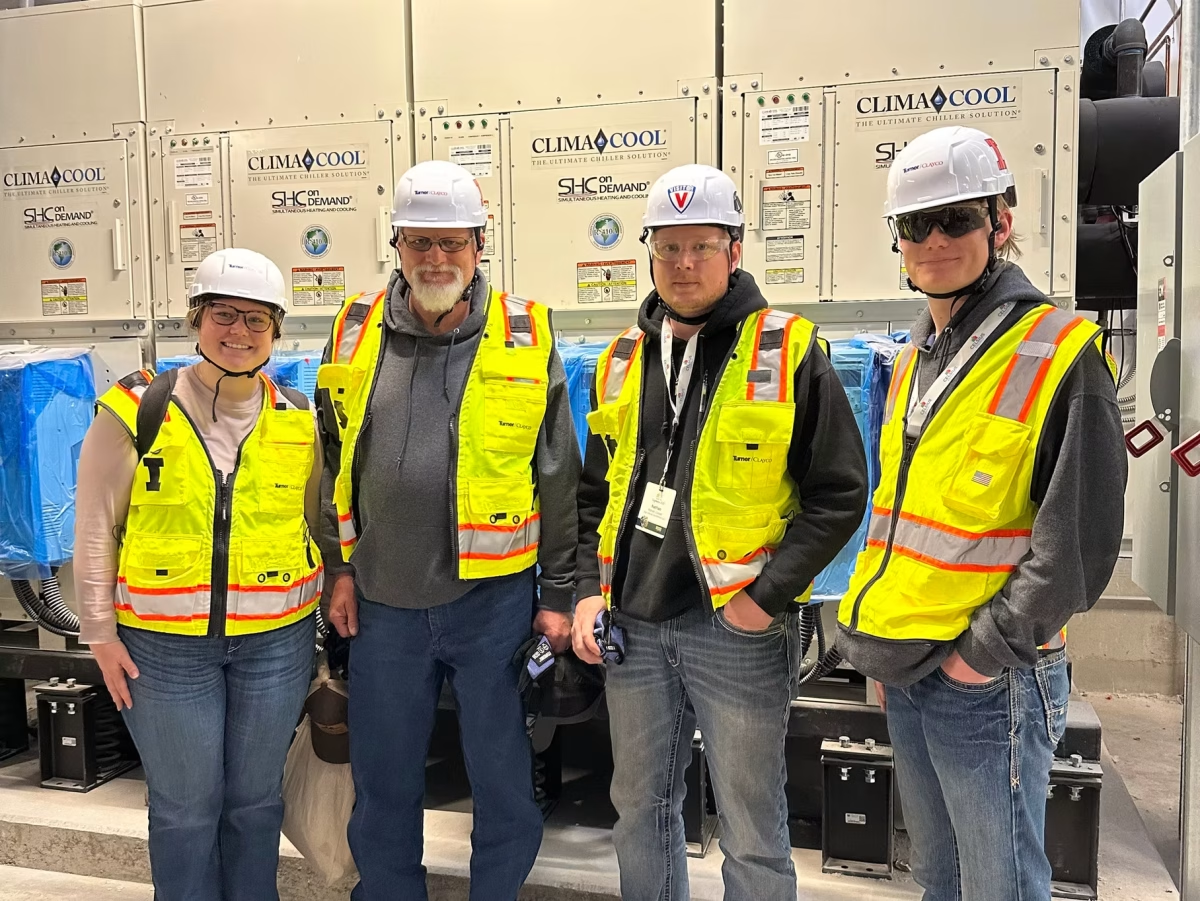
Cooper saw his family’s opportunity and ran with it — starting by getting in touch with Jennifer Pieroni, the Office of Just Transition’s first coal transition navigator. “She helped me navigate the state alphabet soup of agencies,” he said, “that’s the best way I can describe it.”
Brass tacks-wise, she guided the Coopers to people who could help them write a business plan for what’s now the family business, High Altitude Geothermal. The Colorado Energy Office and Division of Water Resources helped them gain an understanding of the regulations they’d need to follow. And still others helped them apply for grants. Along the way, Cooper and the kids did multiple trainings to gain the required certificates to do the work they wanted to do.
“We split it up and all of us covered different classes so we could get as much as we possibly could out of it,” Matt said. “(In the trainings), one of the things they talked about is there’s going to be a real tight electrical grid. We’re not gonna have enough power on the grid in the future.”
And in places like Moffat County, High Altitude Geothermal’s home, where the temperature can drop to minus 50 in the winter, “your electric meter just goes to zinging,” he said, but with geothermal “you use less electricity.”
Rural Colorado going crazy for geothermal
Today, the Coopers offer to “harness the power beneath (their customer’s) feet” through geothermal vertical drilling, loop installation and horizontal excavation.
But the story of geothermal development in rural communities is really just getting started.
On Aug. 20, more than 120 attendees — including U.S. Sens. Michael Bennet and John Hickenlooper, utility executives, state energy leaders and local officials — gathered in Hayden for an up-close look at the groundbreaking for Colorado’s first municipal geothermal network in a mountain town.
The live drilling demonstration showcased the active construction of geothermal heat exchangers to a thousand feet belowground, with “seeing-while-drilling” AI technologies Bedrock says can “read” the earth inch-by-inch during a subsurface construction process to achieve “faster, deeper, less manually intensive and more controlled installation of geothermal.”

The technology is helping to create the infrastructure for thermal energy delivery to the $5.7 million Northwest Colorado Business Park, which is currently under development with the aim to house several small businesses within walking distance of the Yampa Valley Regional Airport.
The Colorado Energy Office’s Geothermal Program, the Colorado Office of Just Transition in the Colorado Department of Labor and Employment and the Colorado Department of Local Affairs all support the project.
It’s just the beginning, according to Lai, who says Vail, Breckenridge, Steamboat Springs and Winter Park are exploring the possibility of geothermal projects.
Others are coming or are already online.
They include Durango, Joes, Eagle, Carbondale, Pagosa Springs, Granby, Rico, Pierce and many other towns and cities, all with the help of grants and tax incentive programs offered by the state, says Bryce Carter, geothermal program manager for the Colorado Energy Office.
And one thing they’re all projected to bring are opportunities for families like the Coopers, who Lai said have “very cleverly, in advance of the coal plants closure, gotten ahead of the curve to go build their own business,” as well the “dozens of small businesses that can then create jobs and stimulate the local economy” across Colorado.
Section by Tracy Ross | Reporter
Sun economy stories you may have missed

➔ Colorado governor cuts spending on Medicaid, higher education and grants to plug $750M hole in state budget. During the special session, the legislature passed a bill ceding the responsibility of cutting the budget to the governor’s office >> Read story
➔ Xcel Energy is rushing to get wind, solar projects online before door closes on tax credits. The utility is about to issue a request for proposals for 4,500 megawatts of generating and battery projects, hoping Colorado regulators OK the projects >> Read story
➔ New mapping shows Lee fire back as 5th largest in Colorado history. The fire burning in northwestern Colorado is 3 acres shy of surpassing the Hayman fire’s footprint in 2002 >> Read story
➔ Price for northern Colorado dams soars to $2.7 billion, scaring a key customer as builders scramble to cut plan. Northern Water has halted multiple contract bids while it scales back designs to hold together a coalition of water agencies >> Read story

➔ A moon rover is driving around a ranch in southern Colorado. Here’s why. >> Read story
➔ Democrats end Colorado’s special legislative session by completing punt on AI law into next year. Senate Bill 4, which would delay the start date of the AI law to June 30 from February, received final approval Tuesday. It now awaits Gov. Jared Polis’ signature. >> Read story
➔ Hundreds lose water source in Colorado’s poorest county with no notice, no warning. Costilla County residents were cut off from the local water filling station when the Fort Garland water board voted to stop sales because of an “angry mob” >> Read story
The Colorado Sun is turning 7 Watch for the members-only happy hour invite! Are you a member?
Other working bits
➔ Colorado honors Labor Day for 138th time Monday. Colorado was the second state to make the holiday official after Oregon, after the Colorado General Assembly passed legislation on March 15, 1887. After 23 states had adopted the holiday, the U.S. finally followed in 1894, according to the U.S. Department of Labor. What’s Working wrote about the history of the holiday two years ago. And that hasn’t changed! >> Local Labor Day history lesson
➔ Colorado’s Quantum COmmons opens. Nearly a year after the groundbreaking ceremony, Elevate Quantum held the grand opening for its new campus in Arvada on Thursday with speeches from dignitaries, including Gov. Jared Polis.
The Quantum COmmons campus still has a ways to go. Still in the works is a 10,000-square-foot fabrication facility and 14,000-square-foot quantum lab that’ll be more like coworking spaces for companies to do prototyping and limited manufacturing of photonic integrated circuits or experiment on commercializing their tech. The lab is expected to open in the first quarter of 2026, while the fabrication building should open by the end of next year.

The 70-acre property, acquired by the Colorado School of Mines for the hub, is located in Arvada off Colorado 72. There’s room for companies interested in relocating or expanding to the region. Elevate Quantum officials said they’ve been working on commitments and contracts this year and work on new custom facilities could start next year.
Elevate Quantum — a consortium of local quantum-tech companies, private investors, universities and public agencies in Colorado and New Mexico — helped attract funding and a federal Tech Hub designation two years ago. The goal is to capitalize on the region’s long history of scientific achievements that have contributed to the quantum industry.
➔ Colorado’s new job board launches. It’s still free. And it’s still called Connecting Colorado, but now one must register to see job details.
As of this week, the job board had 140,970 postings, 875 registered employers and 49,263 registered job seekers, according to the state Department of Labor and Employment. The job listings include nearly 5,000 remote jobs plus jobs located outside of Colorado, according to labor officials.
Anyone on state unemployment must register as part of the requirement to look for a job while collecting unemployment benefits.
The new site is more personalized to the job seeker and provides “smarter job matching,” career planning based on the user’s goals and a resume builder.
Employers can post jobs for free and with the new skills matching feature for workers, employers can “invite top matches to apply directly within the system.”
The labor department said the top five companies on Connecting Colorado this week were:
>> See job board
➔ September is also Workforce Development Month in Colorado. If you need a job or want a new one, lots of events are planned online and in person. >> See calendar
Section by Tamara Chuang | Business/Technology Reporter

Got some economic news or business bits Coloradans should know? Tell us: cosun.co/heyww
Thanks for sticking with us for this week’s report. Share your 2 cents on how the economy is keeping you down or helping you up at cosun.co/heyww. ~ tamara & tracy
Miss a column? Catch up:
What’s Working is a Colorado Sun column about surviving in today’s economy. Email tamara@coloradosun.com with stories, tips or questions. Read the archive, ask a question at cosun.co/heyww and don’t miss the next one by signing up at coloradosun.com/getww.
Support this free newsletter and become a Colorado Sun member: coloradosun.com/join

The Colorado Sun is part of The Trust Project. Read our policies.
Corrections & Clarifications
Notice something wrong? The Colorado Sun has an ethical responsibility to fix all factual errors. Request a correction by emailing corrections@coloradosun.com.