
As I was looking back at the year 2025 for this column — often, I confess, with my eyes half shut and the anti-nausea medicine close at hand — I felt a sudden jolt of reality.
A reality jolt can, of course, be dangerous at any time, but especially at my age and especially at this time, in the menacing first year of the jackbooted Trump Restoration.
But here it is: When I sat down to write my annual column of the Best Books Mike Littwin Has Read in 2025, I realized that this was finally the year I had read too much, which I believed, as a writer, was basically impossible.
Not too many books, of course. God, no. You could no more read too many books than you could eat too much ice cream. Or, speaking of sweet, see too many eyes-half-shut, back-fully-turned passes from the Joker to a back-cutting Jamaal Murray.

Want early access to
Mike’s columns?
Subscribe to get an
exclusive first look at
his columns twice a week.
No, just too much. Too much of everything. Too much of the Epstein files, even the pages that are fully redacted, reminding me of The Black Album in “Spinal Tap.” Too much of Trump’s name on everything. If you’re not offended by the notion of the Trump Kennedy Center, you’re definitely pure MAGA (Make America Gag Again).
Maybe you haven’t kept up, but the U.S. Institute of Peace building is now the Donald Trump Institute of Peace. The Navy is building a new class of warships, called — yes — the Trump Class, which Trump says he plans to help design as part of the new “Golden Fleet.” I hope it goes better than his destroyed-East-Wing-cum-gilded-ballroom, which will probably be named for Melania.
There’s more. The 2026 National Parks annual passes will feature — I swear — side-by-side renderings of George Washington and, yes, Donald Trump, as if to commemorate the 250th anniversary of the signing of the Declaration of Independence. Sure, all men are created equal, but not that equal. (See Trump’s address about what the Declaration means to him.)
There’s more still, but life is too short, and all I can offer that was good about 2025 is this:
A list of the best books I read this year as an escape valve with the hope, as we enter the swamplands of 2026, they can do as much for you.

“What We Can Know”
By Ian McEwan
At 77, McEwan has written his best book since 2001’s “Atonement.” If you somehow haven’t read it, you should get yourself to the nearest bookstore immediately. To my mind, McEwan is the greatest of the many great British novelists of his generation, and if this turns out to be his swan song, we can all happily fly away.
“What We Can Know” is set in the year 2119 in what’s left of Great Britain after the “Derangement” — a climate-change disaster that destroyed much of the physical world — and then the “Inundation” — a nuclear war that set off tsunamis and plagues that killed half the world’s population.

The title refers to what we can actually know — there is a storehouse of knowledge in Nigeria that has recorded every word put to paper or, more often, to cyberspace, every human movement as detailed by our GPS, every in and every out of every life, except those things whispered to ourselves or to our lovers. It’s a biographer’s dream.
But “What We Can Know” is, crucially, even more about what we can’t know. And the wall against which every biographer eventually collides.
Thomas Metcalf —a British scholar of the time who studies literature from 1990 to 2030, and teaches students uninterested by the past and those who left the world in ruins — is obsessed by the past, particularly a lost poem by Francis Blundy, whom McEwan tells us is rivaled as a poet in his time only by Seamus Heaney, read at a legendary dinner party set in 2014.
The party — known to history as the “Second Immortal Dinner,” the first being a 19th-century dinner with Keats and Wordsworth and other such literary worthies — is capped by Blundy’s reading of “A Corona for Vivien.” Vivien is Blundy’s wife, to whom he gives the only copy of the poem, made up of 15 interlaced sonnets, which has been lost to time.
We know everything, but we don’t know what Blundy — a notorious climate denier, by the way — actually wrote about the world of nature or about his love for Vivien or whether the search for the lost classic is justified. Metcalf and his wife risk their lives traveling in post-apocalyptic Britain to find answers. I won’t tell you what they found, or what they guessed, but if you’ve read McEwan, you know that the quest is definitely worth your time.
“North Woods”
By Daniel Mason
This is another fictional story of the known and the unknown, this time as told by those who had inhabited a single yellow western Massachusetts house for over three centuries.
Mason’s stories don’t fit together neatly, just as history doesn’t. The discordant stories read as myths about apple trees and pomomania and the Revolutionary War and abolitionists and illicit love and lobotomy and all the great and small worlds of lovers and loners. The writing is gorgeous as we rely on the house’s witness to carry the stories of love and betrayal.
It’s in many ways a low-tech version of McEwan’s “What We Can Know,’ with its use of wills and newspapers and almanacs and other historical artifacts to bring the fictional inhabitants and their stories to their uneven conclusions.
These are stories of heartbreak and of wonder — including a comedy set piece about vacationers’ erotic dance before the yellow house’s fireplace and the simultaneous “sex romps” of two scolytid beetles in a tree just outside.
The stories, in all their mysteries, are signposts that eventually reveal something strange and fresh about today.
“Outline”
By Rachel Cusk
A few years after reading Cusk’s 2021 novel, “Second Places,” I went back to her famous trilogy of autobiographical novels, “Outline,” “Transit” and “Kudos,” to get a better understanding of her native brilliance.

“Outline,” the first of the trilogy, is about a novelist losing her faith in writing. The novelist, Faye, is traveling to Athens to deliver a writing seminar. She gives us only the briefest sketch of her life while telling the stories of those she meets on the trip who tell her the most intimate details of their lives.
Again, there are set pieces — I guess I’ve got a thing for them —— about a shipping magnate, a divorced editor, a Greek feminist, a man she sits next to on the plane and so on.
These stories, and these lives, are set against hers. At one point, she actually gives something away, telling a story about her sons when they were young and had played an “ongoing make-believe, a narrative which seemed to run like a magic river through our household, inexhaustable.”
Until one of the boys stopped believing and the magic disappeared. Which is much like Cusk’s own life, when writing dried up for her, until she tried on fictional autobiography. I haven’t read the other two parts of the trilogy, but I will.
“The City and Its Uncertain Walls”
By Haruki Murakami
I have read nearly everything by Murakami since “Kafka on the Shore,” a book about cats and Kafka and Hiroshima. Murakami is Japan’s rock-and-roll, West-loving novelist whose latest has been criticized for covering much of the same ground in his long-ago novel of the same city and the same walls.
Somehow, I never read the first book — which started out as a novella of the same name and then included in a later work, “Hard-Boiled Wonderland and the End of the World” — so this is all new to me, a novel about a city and its unforgiving walls in a place where reality and unreality meet, and we’re left to decide which is which.
The story begins with two young lovers, and the girl who tells the boy of the world from inside the walls where she somehow simultaneously lives. The girl disappears, as they do, and the boy, grown into middle-age complacency, still longs for her. So, the boy-man narrator goes looking for the city, where the gatekeeper demands that the man, if he wants inside, must give up his shadow. And his freedom.
The girl, still the same age, is there, but she doesn’t know him. The walls, which have magic and tyrannical powers, keep secret this city that is simultaneously an idyll and a dreary prison, in which unicorns semi-thrive and rivers contain secrets of the seasons. Is it all a dream? Maybe. In this maybe-dream, the narrator spends his time as the town librarian. There are no books in the library, only a catalog of dreams from those who had lived in the town when it apparently flourished years before.
I won’t give much away, except to say that the book is about writing and reading and libraries and the sometimes-oppression of young love, and, of course, of walls that keep us locked in and locked out.
“The Emigrants”
By W.G. Sebald
Every year, I reread a book that has been meaningful to me. “The Emigrants” is especially so. I was on a trip to Cairo soon after 9/11, and I had forgotten to bring a book for the flight. Fortunately, there’s a bookstore at Heathrow, where I found “The Emigrants.”
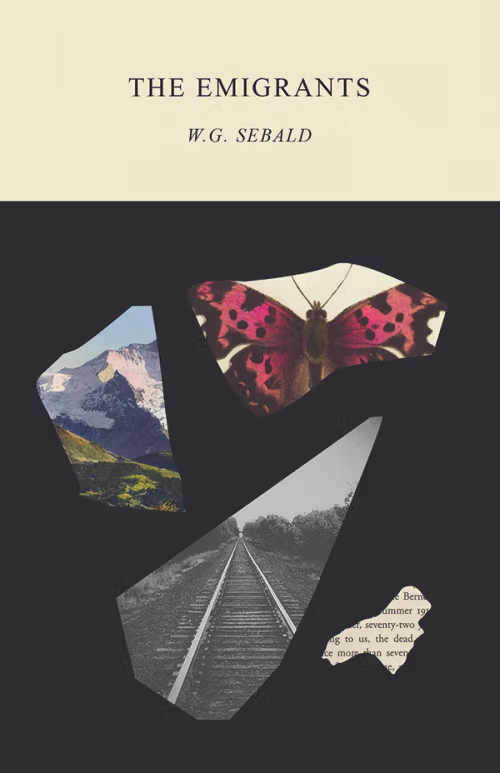
It was so new and strange and brilliant that once my flight landed in Egypt, I raced to crack open the computer to find out more about Sebald’s life. Which, to my dismay, I found had just ended in a car crash, killing him and injuring his daughter.
I was in shock. Suddenly, it seemed I’d lost a close friend. The book — about four Jewish emigres in the time around the Holocaust — seemed less like fiction than biography, with photos cut from magazines embedded in the text, as if to make the characters real. And maybe they were real, or at least based on actual people.
Sebald was a German writer and academic who moved to the U.K., to take up a professorship and write novels, in English, in and around the inexplicable turn his home country had taken during the Nazi era. “Austerlitz” is perhaps the more famous novel of his in the same genre. The style of writing is unforgettable. The interlocking stories are themselves unforgettable. If you read “The Emigrants” once, you will read it again and again and, for me at least, a few more agains. And if you’re like me, you’ll recommend it to every book lover you know.
“Dream Count”
By Chimamanda Ngozi Adichie
This is Adichie’s first book since she wrote the best-selling “Americanah” 10 years ago. During that space, she lost both her mother and her father and you can, at times, see the anguish of what love can and cannot do. And whether we can truly know anyone else.
The story is of four women — three from Nigeria and one from Guinea —whose interlocking lives in the United States are less about their new home than about what women experience everywhere, even in the generous expanse of America.
The writing is what pulls you in. In a review in the Guardian, one writer said it is “quintessential” Adichie: “ambitious, astute and powered by an accumulation of feather-light sentences that build to devastating weight.”
Chia, a travel writer, begins her story of loves found and inevitably lost, with this: “I have longed to be known, truly known, by another human being.”
Can we be known, truly known? Each of the women, three of them highly educated and from well-off Nigerian families, long to know as we hear of their journeys through sordid and futile love affairs.
And then a fourth, the emigre from Guinea who works as a hotel maid, has her life overturned by real-life tragedy involving a billionaire who doesn’t care to know her beyond the devastatingly cruel manner in which he treats her.
When she tells the story of her rape in a locked luxury hotel bedroom, no one believes her, aside from her friends. The rape becomes a huge media story and somehow the maid becomes the gold-digging villain who is powerless to prove the truth.
She is a woman, her friends learn, who is unknown beyond measure.
“Knife: Meditations After an Attempted Murder”
By Salman Rushdie
Rushdie traveled to Chautauqua in New York that fateful day in August of 2022 to deliver a speech on the necessity of keeping authors safe.

On that same day came A — as Rushdie calls his 24-year-old knife-wielding assailant throughout the book — to the same place to carry out the 1988 fatwa delivered by Ayatollah Khomeini when Rushdie was publishing his book “Satanic Verses.”
Khomeini judged the book as anti-Muslim and said that all associated with it, and particularly its famous author, should be killed.
But that was so long ago. And hadn’t Rushdie, after long years of hiding, which ended a decade earlier, finally escaped his doom?
No. He hadn’t. The world had changed in 33 years, but only so much. The assailant had read almost nothing of Rushdie’s work, but that, in its way, was the point of the pointless attack.
”So it’s you,” Rushdie remembers thinking when the 27-second attack began.
We know, if we read the papers, how violent the attack was. But nobody spelled it out quite like Rushdie, who spared no details in describing the deep knife wound to his left hand, two deep stab wounds to his neck, a line of slashes down the center of his body, more to the lower left side, still others to the corners of his mouth, another to his hairline.
☀️ MORE FROM MIKE LITTWIN
And the worst, Rushdie wrote, “was the knife in the eye. That was the cruelest blow, and it was a deep wound. The blade went in all the way to the optic nerve, which meant there would be no possibility of saving the vision. It was gone.”
This is not elegant writing. It’s deep and necessary reportage. It is a record of violence all too primal, violence that exploded in 27 seconds of knife-slashing fury, the same amount of time, Rushdie tells us, it takes to read Shakespeare’s Sonnet No. 130, his favorite.
And yet, it’s also part love story of the wife who nursed him. It’s also a paean to literature and art and culture, beautifully written of course, and to its wages and its costs. He rips open his story as much as the clothes he was wearing that night were ripped from him on stage as doctors worked to save his life.
One doctor would later say he was lucky that he was stabbed by a man who did not know how to use a knife.
We are lucky to be able to read this painful essay, which remains a story of our times.
Next: Two books and one documentary about Donald Trump that aren’t actually about Donald Trump, but might as well be.
I go to history to better understand the terrifying era in which we live.
We’ll start with:
“The Red Scare”
By Clay Risen
It is the oft-told story of Sen. Joe McCarthy and famed journalist Edward R. Morrow and the power of a demagogue who held the lives of millions in his lying hands.
McCarthy is linked to Trump by his notorious lawyer, Roy Cohn, who becomes Trump’s mentor and taught him the especially ruthless laws of success, starting with never apologizing and never, ever, under any circumstances, admitting you’re wrong.
What McCarthy and his allies do best is spread fear. In committee hearings, he questioned those with communist ties, mostly from the ’30s, and those who had the most tenuous of ties or no ties at all.
It didn’t matter to McCarthy who was actually guilty and of what in the red-under-every bed era of Cold War paranoia. Everyone was guilty if McCarthy said so. He had scare lists that didn’t exist. He had a way of ginning up paranoia to levels, as Trump might say, no one has ever seen before.
If you didn’t name names, as McCarthy demanded, you were blacklisted, as many Hollywood writers were, or, even if you did name names, your life could still be ruined.
We get an early look at the rabid right’s rabid dalliance with anti-elitism, anti-immigrant racism and the power of conspiracy thinking that can’t help but give mind to Trump’s retribution tour, his America-Firstism, his misuse of the Department of Justice, his war on truth, his sycophantic advisers and the gutless Republicans in Congress who clear the path for him.
As a bonus, we get an early look at Nixon and how he became Nixon, through, in part, his red-scare alliance with McCarthy. “The Red Scare” reminds us how dangerous American politics and cultural morass can be. As if we didn’t know that already.
“Kent State: An American Tragedy
By Brian VanDeMark
I was a senior in college on May 4, 1970, when young, inexperienced, exhausted National Guard troops at an anti-war demonstration shot 13 students, four of whom died. At my school, as at many colleges, students stormed the administration building, exams were called off and students were sent home.
We went home early, spurred by Neil Young’s devastating “Four Dead in Ohio” refrain and wondering how we could survive Nixon and the darkness of his presidency.

(It should be noted that two years later, Nixon beat George McGovern, 49 states to one. Note to Trump: That’s what a landslide looks like. Two years after that, the Watergate scandal forced Nixon to resign. That’s what the ’60s and early ’70s looked like.)
VanDeMark, who teaches history at the U.S. Naval Academy, gives us an exhaustive — if sometimes maybe too balanced — history of all sides, from Nixon to the SDS (Students for a Democratic Society), from the stunned students to the unprepared guardsmen who fired on them, from a government committed to covering up the truth to a raging country that was near a breaking point.
In the book’s first sentence, VanDeMark writes, “People don’t withhold the whole truth unless the whole truth is too much to bear.”
And so now we see the redacted Epstein files. We see a judge who won’t let Trump send the National Guard into Chicago. We see full-throated paranoia, this time about pet-eating immigrants, then about long-haired anti-Vietnam War protesters.
We see, as then, a country that is losing its way.
“The American Revolution”
A film by Ken Burns, Sarah Botstein & David Schmidt
OK, it’s not a book, but it’s a 12-hour study of the American Revolution and how, in reality, the war was about much more than independence from Great Britain and the price of tea.
Even if you’ve spent some time reading about the Revolutionary War, this doc, shown on embattled PBS, done in the well-known Burns style, will still be revealing.
As historian Alan Taylor says in the second episode, “The greatest misconception about the American Revolution is that it was something that unified Americans. It leaves out the reality that it was a civil war among Americans.”
Among British armies; frightening German Hessians; American loyalists who often fought for King George III and the homeland; Native Americans who struggled to pick a side; American slaves who hoped to win their freedom, but whose cause was abandoned by the slaveowners who stood among the nation’s founders; and the America of Washington and Jefferson and Payne and Franklin and Hamilton and the Adamses and the war that eventually, and at great cost, opened the world to modern democracy.
The war was a complicated violent mess that ended only when the French, who were England’s great enemy, closed off the port in Yorktown, Virginia, in 1781, forcing King George’s great army to surrender to Washington’s troops. It took another two years for a treaty to be written, with the life of the new America still very much at risk.
The revolution was, in its way, the most profound in the world’s history. But these were also, as Payne wrote, the times that try men’s souls. Payne could, of course, write the same today, as he could in many other years of American crisis. But as we watch and see how hard-fought this stab at independence was, we see how much our American democratic experiment is still at grave risk.
What scared the founders, maybe most of all, was the chance their democracy would give way to authoritarianism. As James Madison wrote: “the accumulation of all powers, legislative, executive, and judiciary, in the same hands … may justly be pronounced the very definition of tyranny.”
As we head into 2026, few things scare me more.

Mike Littwin has been a columnist for too many years to count. He has covered Dr. J, four presidential inaugurations, six national conventions and countless brain-numbing speeches in the New Hampshire and Iowa snow. Sign up for Mike’s newsletter.
The Colorado Sun is a nonpartisan news organization, and the opinions of columnists and editorial writers do not reflect the opinions of the newsroom. Read our ethics policy for more on The Sun’s opinion policy. Learn how to submit a column. Reach the opinion editor at opinion@coloradosun.com.
Follow Colorado Sun Opinion on Facebook.