

On an unseasonably warm Monday in February, with high winds and temperatures in the 60s prompting red-flag fire warnings across the foothills, rows of heads filled a computer screen, mostly gray haired and bespectacled.
They were participants in Zoom at Noon, a semi-regular meeting for people wanting to stay up to date on environmental issues started by Phil Nelson, a retired geophysicist with the U.S. Geological Survey. Nelson has long been active in Citizens Climate Lobby, which works to empower everyday citizens to take action on climate policy.
Want to go?
The Colorado Environmental Film Festival takes place Friday, Feb. 20 to Sunday, Feb. 22 at Colorado School of Mines. Find information on films, times, prices and directions at the event website: CEFF.net
Zoom at Noon covers things like the downsides of data centers and “Renewable Energy as a Wicked Problem.” Past speakers have included Leaf Van Boven from the University of Colorado’s department of psychology and neuroscience in Boulder, and Jeffrey Ackerman, a mechanical engineering professor at Colorado School of Mines.
On Monday, however, the guests were a little different. They were Shawna Crocker and Dave Steinke, founders of the Colorado Environmental Film Festival. Nelson had invited them on a few days before the kickoff of the 20th annual festival Friday, to talk about its history, why it’s cool and why it matters.
Right away, one of their defining characteristics emerged: exuberance.

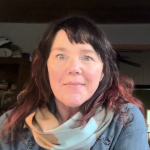
Before Phil got the meeting fully up and running, Crocker’s face filled the screen. Her eyes are deep-water blue and her hair looks like spun silver. She has the air of your mischievous grandmother, who might be sneaking cigarettes. And she’s an environmentalist through and through, who believes “the solution to depression is action,” preferably with people like Mike Nelson, a TV meteorologist for 48 years turned climate activist in retirement, who is spreading the gospel of the supergrid and will discuss it after the last film Sunday evening.
“Can I just jump in?” she asked Phil.
“You bet,” Phil answered.
And she launched into the story of the spark that ignited her idea for the festival.
2005: “Environmentalism is dead”
It was 2004 and she was in Washington, D.C., at an environmental education meeting.
Somebody there said to check out Environmental Film Festival in the Nation’s Capital, at the Smithsonian National Museum of African Art. “And what most impressed me was the number of people that were crowding to get into this theater,” Crocker said. “(Organizers) had to come out and say, ‘Half of you have to leave. We’ll do a second showing later.’”
Around then, a few scientists were starting to question if the environmental movement was dead. They said new and bolder tactics were needed to turn around U.S. policy on global warming. And they pointed their fingers at environmental leaders, blaming them in part for George W. Bush’s reelection after his administration refused to sign the Kyoto Protocol, which committed industrialized nations to legally binding targets for reducing greenhouse gas emissions.
A storm of protests by environmental organizations followed, but not long after, activists started focusing on local government. Mayors from across the U.S., including many in Colorado, signed the U.S. Mayors Climate Protection Agreement, which committed them to adopting greenhouse gas reduction targets.
So when Crocker started thinking film festivals, climate action was very much in the air. “And movies, if they’re made well, can change people’s attitudes, knowledge, behaviors,” she said. It just so happened that the Wild & Scenic Film Festival was selling its package of films with instructions on how to start a festival. So when she returned to her post as an environmental educator with the Colorado State Forest Service, she asked her friend Steinke if he wanted to help.

At the time, Steinke was working as a cinematographer for the U.S. Forest Service, on his way to having a film he made short-listed for an Oscar. His documentary, “The Greatest Good: A Forest Service Centennial,” tells the history of the Forest Service. (Ken Burns did “The National Parks: America’s Best Idea” four years later.)
The patron saint of Steinke’s film is Gifford Pinchot, first chief of the agency. “He said when you’re trying to resolve a problem, always consider the greatest good for the greatest number in the long run,” Steinke said. That was the genesis of the film, which was short-listed for an Oscar in the documentary category.
As Steinke tells it, Crocker said Americans needed a film festival “between the coasts.” She’d seen what Wild & Scenic was doing and thought, “Whoa, we are missing a huge slice of the environmental education pie in Colorado — people who don’t come to our hikes or trainings, our workshops, programs or classes, but they go to a movie.”
They got together, put the word out, received some films and got going. Their first year, they showed around 10 Wild & Scenic films to a tiny audience in the American Mountaineering Center in Golden.
When they started their festival, Crocker said it was “very grassroots, figuring it out as we go, every step of the way, with few attendees, before YouTube and no electronic submissions.” But as they grew, so did their audiences, until, “when we hit five years, we were kind of legitimate,” Steinke said, “with a budget, a director, two theaters,” and the distinction of being the largest environmental film festival between the coasts.
Today’s film festival
“Now here we are, 15 years after that, with a $100,000-a-year budget, a nearly full-time director and we just hired a digital director to handle all media,” Steinke added. “So it’s an ongoing, real, honest to goodness, biggest environmental film festival between the coasts, and we were just looking at the statistics.”
In 2025, they received 122 submissions from the United States, 11 from Brazil, 10 from the United Kingdom, 10 from Canada, nine from Australia, eight from France and 42 from other countries. Of those entries, more than 50 will run Friday through Sunday at the Green Center at Colorado School of Mines in Golden.
There will also be an “eco-expo community showcase,” highlighting the ideas and wares of local environmental action groups and environmentally minded organizations. Between 300 and 400 kids in grades 4 through 12 will have their own time to watch films — all by kids — on Friday morning. And festivalgoers will learn ways to take action on climate initiatives they find important.

But in some ways, the festival is more about a feeling than watching reels, especially when the environment is under attack. A quick scroll through the Climate Action Campaign’s tracker of climate and clean energy rollbacks in President Donald Trump’s second term makes that clear.
Phil Nelson says the film festival is more important now than ever “as the current administration continues dismantling the progress on climate change of the last decade that was put in place by the federal government. The CEFF films keep us all aware of the many efforts underway by individuals, by organizations, in agriculture, and yes, even the construction industry, to cut emissions.”
And Crocker knows people who worry about such things need a reminder that they and other climate worriers, and climate warriors, are in this together.
“I used to open a festival every year by saying, ‘I know I’m talking to the choir here, but that’s OK,’” she said. Then she realized she needed to extend her reach, “because our festival serves as a rejuvenating, uplifting, team-building event for all of us who are demoralized or sad.
“We’re good for that, even though we don’t have specific political leanings. We encourage people to talk about our films and talk with the filmmakers. And our filmmakers are passionate. They are not out to just make a fast buck. They just want their films to be seen.”