
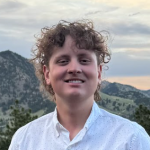

Ryan Chrapko ate some psilocybin half an hour ago. He’s been staring at the same tree now for 10 minutes. It wasn’t a lot of mushrooms, only about a quarter of a gram. It’s just enough to unlock a sense of childlike wonder in his psyche at this particular moment.
It’s almost like he’d never seen an evergreen before, with its infinite number of thin needles pointing up toward a clear blue sky.
“It’s funny that I’m talking into this microphone right now while looking at that. It’s really the reason why I like to come out here. It’s mountains, it’s a beautiful scene,” Chrapko said. “Beauty, nature — it’s a reminder of who you are.”
At this moment, he’s a happy camper. Go back four years and he was miserable.
In March 2020, as a junior in high school, Chrapko’s mental health was at an all-time low. He was self-medicating with alcohol, marijuana and illicit prescription medications. They just made the problem worse. He wasn’t doing anything to address either issue. Instead, he was taking things out on others.
“I didn’t have the greatest relationships with my parents or a couple of other friends at the time, I didn’t treat people kindly. I wasn’t a great person,” Chrapko said.
Then the COVID-19 lockdown hit and he began experimenting with psychedelics. What started as recreational use would soon change his life.
“After quarantine, I noticed, like, dramatic personality changes,” Chrapko said. “The way that I thought … underwent a revolution.”
He became one of a growing number of people who have turned to psychedelic use to treat disorders ranging from post-traumatic stress disorder to anxiety and depression.
Over the last four years, he’s primarily used psilocybin, also known as magic mushrooms, to address the root causes of his issues and work toward growing as a person. During all of that work, Chrapko has been on his own but he wishes he had a professional who could have guided him through his journey using the drug to grow.
“I had to process and integrate on my own initiative, but in retrospect, I think it would have happened a lot sooner if I had some counsel,” Chrapko said.
Starting in January, Coloradans will be able to have that guide as a law passed by voters in 2022 kicks in. Proposition 122 allows professionals, like therapists and psychiatrists, to administer the psychedelic psilocybin in a clinical setting, opening the door to a new frontier of psychotherapy.

A new type of medicine
Among other things, Chrapko has noticed that he’s gained more empathy, felt more grounded and has lost the desire to drink alcohol or use drugs other than psychedelics. He has also found an interest in religion and philosophy.
Jim Grigsby, a clinical psychologist and executive director of the new CU Denver Center for Psychedelic Studies, says those personality changes can be traced to how psilocybin interacts with the brain. High doses of psychedelics can produce a state of consciousness that’s sometimes referred to as a mystical experience or psychedelic peak. The less clinical term for this is tripping balls.
“It’s one in which people lose their ordinary sense of self, who they are, and their boundaries by the people and with the world,” Grigsby said. “We actually see changes in brain functioning that seem to be associated with this loss of a usual sense of self.”
That change in brain functioning is commonly referred to as ego dissolution, Grigsby said. A study from the Washington University School of Medicine in St. Louis documented those changes. Researchers used MRIs to scan people’s brains while on psilocybin and found that the drug causes the brain to disconnect from its typical pathways and reconnect to different parts of the brain.
Those effects can be incredibly beneficial in a therapeutic setting. Grigsby was part of a study that used another psychedelic, MDMA, to treat psychiatric trauma. The drug appeared to have a direct effect on certain aspects of memory. It allowed patients to rebuild their interpretation of those memories to experience less of a negative effect from them.
“Memory is stored not in a place in the brain, but in collections of neurons,” Grigsby said. “It looks like the psychedelics are able to induce a rewiring (of the brain) so that the way the memory is remembered changes, and it can reduce the severity (of trauma).”
But all of these changes are not necessarily permanent. That Washington University study found that most of the brain’s networks returned to normal in the days after the psychedelic trip. But, some of the effects on the brain lasted for up to three weeks. Another study released in March saw effects from LSD last up to 12 weeks.
But Grigsby believes that without psychotherapy complimenting the drug most psychedelic users don’t see major shifts in their mental health.
“If you could just take the drug and have significant change, then when you think about what goes on at Red Rocks during Phish concerts, there’d be a whole lot of people having experiences that were very therapeutic for them, (but) mostly they’re just having a good time,” Grigsby said.
When therapy is incorporated with use of the drug, especially in that brief window of rewiring, Grigsby thinks true psychological changes can occur. He is currently leading a study that is using psilocybin to treat existential stress, including depression and anxiety, among individuals with late-stage cancer.
The trial incorporates several sessions of therapy, which he explained is similar to how most psychedelic research trials for mental health treatment have operated across the country. “That therapy keeps people focused, gives them a feeling of safety, and then helps them to deal with what came up (in the trip),” Grigsby said.
While the trial is ongoing, he said the initial results have been promising. But providing a psychedelic peak experience, or trip, is not the only way psilocybin can be used to help people.
The neurological benefit
Throughout Pete DePrez’s life, he’s incurred serious trauma to the brain. As a baby he flipped out of a stroller and went headfirst into a dresser, knocking himself out cold. From there, he got countless concussions as a high school football player and spent 12 years as a first responder, including seven years in law enforcement.
In that job, he was frequently exposed to blast trauma, which is when a person absorbs the sonic blasts from explosions including the small ones produced each time a weapon is fired.
“I was a firearms instructor, I was on the SWAT team, so I was spending a ton of time in this environment where I’m just eating these sonic blasts,” DePrez said.
After being too close to two of the flash bangs, the wheels started falling off. He struggled with severe short-term memory loss, often forgetting where he was driving while behind the wheel. At certain points, he lost the ability to hold a conversation and even just form sentences.
He’d been sober through his entire 30s but started drinking himself to sleep at night to manage his debilitating insomnia and tinnitus.
And that wasn’t even the worst part.
“I spent three months in a heavy suicidal ideation space where every day I knew … at some point, I was going to have to talk myself out of taking my own life,” DePrez said.
He’d been diagnosed with PTSD and had to end his career in law enforcement. But he never felt like he’d been traumatized by his work. It was more like his brain had just stopped working. Eventually, he saw a neuroendocrinologist, who quickly made the correlation between his symptoms and repeated traumatic brain injuries.
All of the head trauma had caused neuro inflation, also known as brain swelling, which was the root cause of his symptoms. A neurophysiologist suggested a solution to his condition. Surprisingly, it was microdosing mushrooms.
“Probably within five days, my brain was functioning in a much smoother pattern,” DePrez said.

This is because of psilocybin’s unique ability to help regenerate the brain. The neuro inflammation DePrez experienced triggers cellular degeneration in the brain. Just like the liver the brain can reverse course and cellularly regenerate if given the opportunity.
Grigsby uses the technical term neuroplasticity to explain this. Psilocybin encourages neuroplasticity or cellular regeneration, which helps reduce brain swelling and the symptoms that DePrez was experiencing. Essentially, it helped heal his brain and return him to normal.
His positive experience with the drug has led him to be a major advocate for it. He helped advise on multiple elements of the drafting of Proposition 122. Additionally, as a former sheriff’s deputy DePrez thought he had a unique ability to testify about the lack of crime he saw the drugs causing.
“The majority of my career on the road was spent chasing heroin and methamphetamine. Those were the two drugs that I saw having the biggest impact on society,” DePrez said. “But I didn’t see that with psychedelics ever at any point in my career.”
The emerging industry
While Proposition 122 does decriminalize personal possession, the legalization of psychedelics in Colorado will look very different from the 2014 rollout of recreational cannabis. The sale of psychedelics remains illegal and there will not be any retail stores where the drugs can be purchased. Instead, a new industry of “healing centers” and licensed facilitators of natural medicine services will be popping up.
The Department of Regulatory Services and Department of Revenue have spent the two years since Prop. 122 passed crafting regulations for both the business and licensure side of this new industry. They have defined healing centers as entities licensed by the state that permit a facilitator to provide and supervise natural medicine services.

For now, those services are limited to administering psilocybin. But the law allows the state to expand the list to include other plant-based psychedelics like ibogaine, mescaline or dimethyltryptamine, known as DMT, starting in 2026.
“I think we’re going to see primarily pretty good or mutual outcomes,” Grigsby said. “So people will think ah it’s OK and interesting, and other people are going to say that was one of the most profound things I ever experienced.”
There are two types of professional licenses as well. One is for medical and mental health providers to practice psychedelic-assisted therapy. The other would allow nonlicensed health professionals to offer services like therapy or acupuncture assisted by psychedelics. Training programs for these licenses have already begun and applications for licenses will open Dec. 31.
It’s unclear how long it will take to process licensing for both businesses and professionals. But if it’s anything like the 2013 rollout of recreational marijuana, healing centers will rapidly mushroom into existence across the state over the next year.
After his successful experiences with psychedelics, Chrapko hopes to go into the new industry as a therapist. The senior at the University of Colorado is currently a psychology major and president of the CU Psychedelics Club.
He wants to be the guide through psychedelic therapy he never had, because psychedelics helped him grow into the person he is today.
“Psychedelics kind of gave me my life,” Chrapko said. “I was going down a pretty dark path, and psychedelics, four years later, have brought me into the state of flourishing.”