


They are not related but they might as well be. Crested Butte adventurer Eric Larsen has the same restless, unsettled mien of Sir Ernest Shackleton, the fabled explorer of the Antarctic.
It’s like they share the same genes, Larsen and Shackleton. The frigid adventure beckons. And they leap.
“We have mapped and charted the face of our planet. So the leading edge of adventure lies in not necessarily discovering a place but pushing our limits in that place,” says Larsen, the world’s most accomplished polar explorer, sitting in an airport in Chile a few days before clicking into his skis and harnessing his sled to set a new speed record for a solo, unsupported trek to the South Pole.
Larsen has trekked to the North and South poles more frequently than any other American. In 2010, he became the first and only person in history to reach the South Pole, the North Pole and the top of Mount Everest in a single year. In 2014 he finished what will likely be the last human-powered expedition to the North Pole, skiing, trudging and even swimming across the partially frozen Arctic Ocean. He’s trekked to the South Pole four times, including once on a bike.
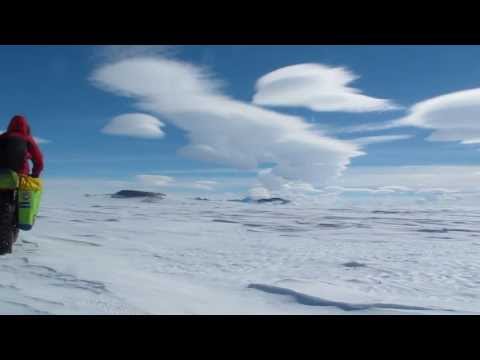
In the next few weeks, he will lean into Antarctica’s notorious gales, pulling a 150-pound sled and race to the bottom of the world. His plan is a meticulously scheduled assault across 700-plus miles of barren ice. If all goes as planned, he will reach the pole in 22 days, shaving two days off the 2011 record set by Norwegian Christian Eide, who shattered the previous record of 39 days by skiing at a seeming sprint, covering an average of 30 miles a day.
Larsen sees the speed record as something akin to the audacious free climb of the Yosemite Valley’s Dawn Wall by rock climbing superstars Kevin Jorgeson and Tommy Caldwell in 2015. The face had been climbed before, but not in a single push. Jorgeson and Colorado’s Caldwell changed that, clearing room on the sport’s crowded trophy shelf for a new level of athleticism.
“That’s kind of like what this is. People have been to the South Pole, but this is pushing the edge of what is physically possible,” Larsen says.
The icy expanse of the lonely continent has lured adventurers for more than a century, and this year is no different. Oregon’s Colin O’Brady is there now, attempting to be the first person to cross Antarctica without any support or aid. It’s been only 10 years since doctors told O’Brady he’d never walk normally again after an accident left him with severe burns on his legs and feet.
On Wednesday, the 12th day of a a mission he’s dubbed “The Impossible First,” O’Brady posted an update from the ice. He had spent the day in a whiteout, unable to even see the ground. Earlier, he had described the blinding whiteness of Antarctica as “standing inside the belly of a ping pong ball.”
“Imagine waking up at your house. After eating breakfast, you sit down in a dimly lit room at a table and you look down at a compass never taking your eye off it for the next 12 hours. Maybe try that tomorrow, if you want a taste of what my day was like today,” O’Brady posted to his Instagram page.

Adventurer Louis Rudd, 49, also is on the ice right now, attempting the 930-mile traverse of Antarctica. Last year Rudd and five other British Army reservists completed the unassisted journey across the continent, reaching the South Pole and finishing at the Ross Ice Shelf. This year, Rudd joins O’Brady in a quest to become the first person to cross Antarctica solo and unassisted, with no food caches or help of any kind.
Rudd’s mentor, Lt. Colonel Henry Worsley, was a mere 30 miles from reaching the Ross Ice Shelf in January 2016 when he collapsed. The 55-year-old former British Army officer had covered more than 900 miles over 71 days and was just a day from becoming the first to traverse Antarctica when he died, succumbing to exhaustion and dehydration.
On Christmas Day 2017, Scott Sears became the youngest person to ever reach the South Pole on a solo expedition. The 27-year-old lieutenant in the British Army pulled his sled for 38 days, across 702 miles of ice to reach the South Pole.
Three days later, British polar explorer Ben Saunders — another friend of Worsley’s — abandoned his quest to cross Antarctica after arriving at the South Pole in 52 days. He did not have enough food for the final push to the Ross Ice Shelf and pulled the plug at the pole.
Steamboat Springs attorney and adventurer Doug Tumminello was laboring toward the South Pole in January 2016 as Worsley was trekking across the continent. He was planning to reach the South Pole in 50 days but equipment issues, high winds and nagging injuries slowed his pace and he relinquished his goal shy of the pole.
Tumminello says many Antarctic explorers consider Eide’s 24-day speed record “to be unbeatable.”
“But you know how that tends to go,” Tumminello says. “If anyone has a shot at beating the record, it would be Eric. He’s an absolute animal and has lots of experience in all of the polar regions. Eric is arguably the most experienced polar explorer alive. He’s so experienced on the ice, and so efficient, that I expect he’ll give the record a serious go.”
Larsen is 47. He’s got a wife and two young kids at home in Crested Butte. He built an ingenious computer station, dubbed “Mission Control,” so his family can track his progress. He’s not feeling this mission is particularly risky. His career in the world’s most desolate, frozen terrain has given him a skill set few possess. It’s more than strength or even mental focus. It’s about self-discipline, he says.
“This is not necessarily about going faster, but longer,” he says, noting the need to travel at least 2.5 miles-per-hour for 12 to 16 hours a day in the next few weeks. “And I’m at a point in my life where I have gained enough knowledge to know how to do that.”

Partnering with the athlete-led climate advocacy group Protect Our Winters, Larsen hopes his speedy push to the pole — part of his years-long personal goal to “Keep Cold Cool” — will amplify discussion around climate change and how melting polar ice caps are impacting everyone, everywhere. In many ways, as the warming climate makes polar travel more difficult, Larsen fears his lifelong pursuit of firsts has become a race for “lasts.” He’s calling this Antarctic trek “The Last South.”
“A big part of this for me is just having these conversations about places like this, now more than ever. The conditions are changing there. I’ve seen a dramatic change,” he says. “The writing is on the wall for any place that is icy. I just want people to see that ‘Hey, guess what, ice is an endangered species.’ That’s a big part of this, just engaging people in that conversation and the adventure.”
In 2014, Larsen and partner Ryan Waters completed their human-powered expedition to the North Pole, racing across drifting ice that pulled them away from their pole goal, swimming across open stretches of frigid water and eluding hungry polar bears. The duo’s 53-day slog is not likely to be repeated without a momentous shift in the climate.

Last fall Larsen biked, hiked and packrafted from the eastern edge of Colorado to the western border. It’s part of his quest for a triathlon-type traverse of each state. He did Wisconsin this fall. That’s on top of a polar training expedition he led on Lake Winnipeg, guiding in the Arctic and skiing across Greenland in the last year.

On each expedition, he navigates not only grueling physical demands, but overwhelming mental angst. Somewhere deep in the sufferfest, he questions everything. His decisions, his purpose, his pursuit of arbitrary, self-designed adventures. It doesn’t last.
“It goes something like this: You have kids. You’re a failure. What are you doing? You should quit and get an office job,” he says. “Then at some point I break through and feel awesome and love what I’m doing. Every time that happens.”
He’s old enough to know it’s coming. He knows how to suffer. After more than 20 years adventuring in the harshest of conditions, he knows what to expect and plans for it. It’s about focus, Larsen says.
“I could not have been able to do this trip as a younger man for a lot of reasons,” Larsen says. “When you go out and do something you’ve never done before in uncertain territory, there’s a lot of anxiety. I don’t really have that here. I know how my body works. That knowledge doesn’t make it easier, but I know what to expect. Yeah, it’s hard. But it’s nice to be able to do a hard trip with a cool objective and still feel like I’m challenging myself on a personal level.”

☀ OUR RECOMMENDATIONS
- Colorado SunFest 2026 Panel: Challenges and solutions for an aging population
- The Colorado Sun is exploring solutions to the state’s water crisis. Here’s how you can help.
- Colorado SunFest 2026 Panel: How Coloradans are feeling heading into a big election year
- Lawmakers want to quickly get out-of-state teaching licenses qualified for Colorado classrooms
- The Grand Traverse ski race from Crested Butte to Aspen confronts warming winters