


A Republican state representative’s demand last week that Colorado’s 661-page budget bill be read aloud in the House froze work in the chamber for 15 hours and cost taxpayers upwards of $10,000, according to an analysis by The Colorado Sun.
State Rep. Brandi Bradley of Littleton forced the reading in protest of the House’s handling of an ethics complaint she filed last year against a fellow GOP state representative, Ron Weinberg of Loveland. A bipartisan ethics committee investigated the complaint and recommended that House leadership send Weinberg a letter of condemnation and encourage him to get workplace harassment training, which they did.
Bradley said in a speech on the House floor that she was having the bill read at length “until such time as we commit to address our own shortcomings, the injustice of our own rules and bring both light and victims to justice in this House.”
Later, Bradley said on social media she was also having the bill be read at length to protest what’s in the state’s $46.8 billion budget.

A provision in the Colorado Constitution grants any state lawmaker the ability to request that a bill be read aloud and requires that the request be honored without debate or a vote. The clause was part of the document when it was originally approved by voters in 1876, and records from the period show the state’s founders aimed it at preventing the hasty passage of legislation.
But the provision also hearkens to an even earlier time, when mass printing was impractical and literacy rates were much lower.
In recent years, Republicans — who have been in the legislature’s minority since 2019 — have used reading bills at length as a form protest and to delay work. They’ve mostly deployed the tactic sparingly, however, and to extract concessions as an organized group.
The length of the bill Bradley had read aloud, and the fact that she did it on her own, sets her demand apart from instances in recent years when Republicans forced bills to be read in full.
Democratic leadership in the House had the budget bill — which is spread across 38 separate documents and is full of spreadsheets and numbers — read by a computer program named Eric over two days to limit the impact on Capitol staff. On Thursday, the bill was read for about five hours, ending at about 11 p.m. On Friday, the bill was read for 10 hours, starting at about 10 a.m. and ending at roughly 8 p.m.

Each day the Colorado House is in session costs taxpayers at least $14,212. That includes the per diem and mileage reimbursement paid to lawmakers, as well as the costs of their retirement and paid leave benefits. It also includes the salaries and benefits paid to staff who only work during the legislature’s regular, 120-day lawmaking term, which spans each year from January to May.
That comes out to a cost of about $592.17 per hour, or $8,882.55 over 15 hours.
But the $14,212 daily cost does not include what’s paid to full-time staff (like the legislature’s nonpartisan lawyers and senior nonpartisan staff in the House, such as the chief clerk) and it does not include the cost of running security checkpoints at the Capitol or for janitorial staff. The cost of utilities — the electricity and water used at the Capitol — is also not part of that number
Finally, the $14,212 also doesn’t include what’s paid to the dozens of partisan staffers who work for the House Democratic and Republican caucuses and individual members.
When you factor in all of those other costs, the tab borne by taxpayers to read a bill at length for 15 hours would easily exceed $10,000, though the exact amount is likely impossible to calculate.
Bradley, in an interview Tuesday with The Sun, defended the cost.
“What’s the cost of victims not being heard in the state assembly?” she said. “Does that come at a dollar? Five dollars? Five-hundred dollars?”
She feels like she accomplished her goal of raising awareness about what she believes are shortcomings in the House’s ethics rules that let representatives escape accountability. Bradley also thinks forcing the bill to be read aloud highlighted parts of the budget that she disagrees with, namely continued spending on health care for immigrants and cuts to Medicaid services for people with developmental disabilities.
The political cost for Republicans
When Eric the computer program finished reading the budget bill on Friday, Democrats limited further debate on the measure to one hour.
As a result, time ran out before more than two dozen amendments — most of them from Republicans — could be debated and voted on.
Then, Democrats forced the House to work on Saturday so that the legislature could stick to its schedule, which calls for the budget to be debated in the Senate this week. That created a conflict with the Colorado GOP’s state assembly Saturday in Pueblo.
All but two Republican state representatives missed the assembly because they were in the House.
Some House Republicans were upset with Bradley’s request that the bill be read at length and have sought to distance themselves from her.
State Rep. Mary Bradfield, R-Colorado Springs, told Colorado Politics what Bradley did was tantamount to a “temper tantrum.” State Rep. Dusty Johnson, R-Fort Morgan, told the news outlet she would have rather debated the bill than listen to it.
The decision of when to have bills read at length is typically a caucus decision, said House Minority Leader Jarvis Caldwell, a Colorado Springs Republican. But that wasn’t the case with the budget bill, also known as the “long bill.”
“It was a decision of one member,” Caldwell said of Bradley.

Caldwell told reporters Monday that Bradley’s demand that the bill be read at length was a “complete and total surprise to the caucus” that prompted Democrats to limit debate on the budget.
“We had 20-plus amendments that our members wanted to run on behalf of their districts,” Caldwell said. “They got robbed of doing that.”
Caldwell and state Rep. Matt Soper, a Delta Republican, said Bradley’s decision to have the budget be read at length also eliminated a bargaining chip for the GOP. The party has used reading bills at length as a way to protest Democrats’ bills, with reading the budget — one of the longest bills debated by the legislature each year — being considered the nuclear option.
Soper said reading the budget bill at length was something Republicans have used to exert influence over Democrats, but never acted on. Now that Democrats have proved it is possible to navigate reading a bill at length with minimal consequences, Soper said the tool is gone.
“The minority should be able to leverage these tools to try to make bills better for the state of Colorado,” Soper said. “When these leverage pieces go away because one member decides to go rogue, it hurts the state of Colorado.”
Bradley argues it’s solely Democrats’ fault the House worked on Saturday, calling the decision vindictive and arguing the budget debate could have been pushed into this week. She questions whether Republicans would have been forced to work on Saturday either way.
But House Majority Leader Monica Duran, D-Wheat Ridge, said that she informed Republican leadership, namely Caldwell, that representatives would be called into work on Saturday if the budget bill was read at length. Duran said her plan was to finish the budget debate on Thursday and give Republicans Friday and Saturday off so they had plenty of time to participate in the state assembly.

Caldwell confirmed as much to The Colorado Sun, and said that he believed his caucus was aware of the consequences, too.
“It is because Brandi read the bill at length that we ended up working on Saturday,” Duran said. “Plain and simple.”
Bradley told The Sun she was never informed by Caldwell that reading the budget bill at length would prompt a Saturday workday. She is disappointed at the criticism she’s gotten from fellow House Republicans, calling Soper’s argument about eliminating a negotiating tool “uneducated.”
“They would have been heroes in my eyes if somebody had” forced the bill to be read at length, said Bradley.
She has the support of some of her GOP colleagues, including Reps. Ken DeGraaf of Colorado Springs and Stephanie Luck of Penrose.
“Reading the long bill at length helps expose the perfunctory nature of the budgeting process,” DeGraaf said.
Bradley could have forced the budget bill to be read a second time on Saturday, when the measure came up for a final vote, but she opted not to exercise that power.
Bradley’s complaint against Weinberg
Bradley lodged her ethics complaint against Weinberg in July. That prompted the formation of a House Ethics Committee to investigate her allegations and determine what, if any, punishment should be leveled against Weinberg.
Bradley alleged that Weinberg screamed at her during the 2023 legislative session, that she repeatedly smelled alcohol on his breath at the Capitol, and that on “multiple occasions” he “made inappropriate and sexual comments.” One of those alleged comments was about two other female Republican colleagues’ genitals and fellatio.
Finally, Bradley claimed that Weinberg made a copy of a master key to unlock rooms at the Capitol and used it.

After a monthlong process, Weinberg rescinded his request for a hearing on the allegations, which prompted the ethics committee to vote on whether there was probable cause that Bradley’s accusations were true.
The House Ethics Committee, made up of three Democrats and two Republicans, found there was probable cause to believe that Weinberg used a master key to access unauthorized areas within the Capitol and that he made inappropriate sexual remarks in violation of the General Assembly’s workplace harassment policy. (Weinberg has denied the allegations, calling them “categorically false, misleading and without merit.”)
The panel voted unanimously to recommend to House leadership that Weinberg be formally admonished for a pattern of unbecoming behavior and that leadership recommend to Weinberg that he get additional sexual harassment training.
House Speaker Julie McCluskie, Duran and Caldwell honored the House Ethics Committee’s request and sent Weinberg a letter on March 27.
“Such behavior is inconsistent with the standards expected of a member of the legislature and is unbecoming of your office,” they wrote.
The letter was published in the House journal and the ethics complaint process was considered over.
But Bradley felt that wasn’t enough, saying the ability of Weinberg to decline a hearing and effectively end the inquiry was a loophole. She felt she should have had an opportunity to share her story in public.

“If the accused can shut down accountability at any time, why would any victim feel safe coming forward?” she posted on social media. “We don’t need a system that protects the process, we need one that guarantees accountability.”
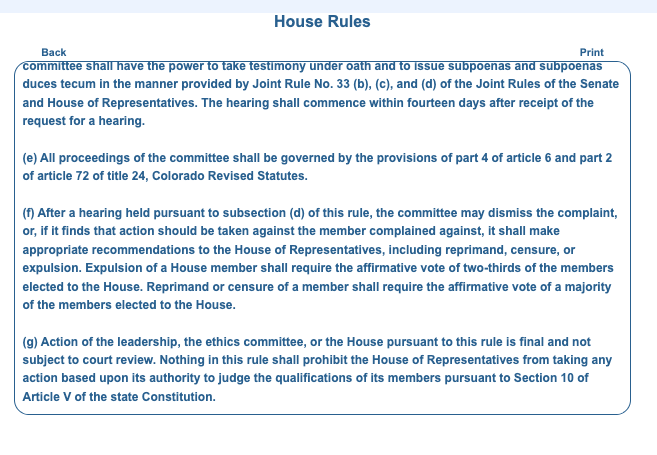
She also wanted the full House to weigh in on the ethics committee’s findings, which, in her interpretation of the House’s rules, is required.
“The way we read it and outside counsel reads it is that any recommendation from the ethics committee comes to the House,” Bradley said in an interview. “They’re going to agree to disagree with that. Either way, the rules have to be cleared up.”
Bradley said she met with McCluskie, Duran and Caldwell about the need to update the House’s ethics rules, before having the bill read aloud, and that the leaders promised to review them after the lawmaking term ends in May. But she didn’t feel that was sufficient and pushed for faster action given how McCluskie and Duran are term-limited and won’t be returning next year.

“I wanted a contract,” Bradley said. “I wanted it in writing. It’s a guardrail moment for me. Why wouldn’t they be hell bent on changing it now?”
McCluskie and Duran told The Sun there’s not enough time left in the busy final weeks of the legislative session to take on such a big task, which they want to do in coordination with the Senate and after researching how the process works in other states.
Bradley hoped that having the bill read at length would force immediate change. That didn’t happen.
A spokesperson for McCluskie and Duran said they remain committed to reviewing the ethics process after the legislative session ends — but now without Bradley.
“We welcome insight on how the rule can be improved, but given her engagement the last week and reading the long bill at length, we notified the minority leader that we will seek to work with other members on revising the rule including those who served on recent ethics committees,” said Jarrett Freedman, the spokesperson.
Bradley said she never expected to be included.
The budget debate continues in the Senate this week. Barring any more delays, the document should be finalized and sent to the governor for his signature sometime before the end of the month.
KUNC Capitol Editor Kyle McKinnon contributed to this report.