
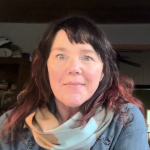

There’s a moment in “Line of Fire,” a new documentary about sexual abuse on the U.S. Women’s Biathlon Team, when it feels like the camera will linger on its subject’s face forever.
That’s because her pain is so visceral. And it’s the kind of pain that’s hard to witness.
She is Joan Wilder, in her late 50s. When she was 20, she says, a coach hired by U.S. officials to prepare the women’s team for their first-ever biathlon Olympics tried to force her to have sex with him after she’d gone to bed one night. The coach denied it. And when Wilder reported it to her team manager, Max Cobb, who later became U.S. Biathlon Association CEO and is now secretary general of the International Biathlon Union, she says he blew it off. No charges were ever filed.
Wilder later said in a SafeSport complaint that she faced retaliation for pressing the issue of firing her coach. She quit biathlon, which combines Nordic skiing and shooting at set targets, after being bumped from the 1994 Olympic team and then dropped from the national team without notice, just before the 1998 Olympics. That left her without health insurance. But when asked why she didn’t keep pushing to oust her abuser, she said she had lost the fight it would have taken to do so.
Last December, several national news organizations ran the story, and on Dec. 17, Cobb publicly apologized to any athlete who “comes forward with issues, especially issues of sexual misconduct,” who were mistreated during his tenure as the head of the U.S. Biathlon Association.

It’s one thing to witness a person’s pain from the distance of a theater seat or computer screen. But the person who saw it up close, and who had the composure and compassion, not to mention the confidence to capture it, was a 17-year-old filmmaker from Grand Junction High School named Cameron Kirkegaard.
Kirkegaard’s 40-minute documentary covers not only Wilder’s painful past but also that of other women who say they were sexually assaulted during a period when abuse and misogyny were tolerated by biathlon team management for decades. It focuses on them coming forward to major news outlets, and how she and two-time Olympian and University of Colorado athletic hall of famer Joanne Reid led a biathlon camp, put on by the Colorado Biathlon Club at Snow Mountain Ranch in Grand County. They wanted to teach women about what might be the United States’ most obscure skiing discipline but one of Europe’s most beloved, while showing support for athletes who’ve faced sexual abuse, including those who may never come forward.
“Line of Fire” premiered at the Avalon Theater in Grand Junction in October. Kirkegaard turned 18 on Monday, and has some thoughts on his moving and unflinching film. Its next screening is planned for Jan. 17 at Snow Mountain Ranch.
This interview has been edited for length and clarity.

The Colorado Sun: The film centers on a four-day women’s biathlon festival at Snow Mountain Ranch. Why was that event created and how does it relate to the biathlon abuse scandal?
Cameron Kirkegaard: The festival was put on by Wilder and Reid and a couple of other elite-level athletes, and consists of races and information clinics on how to ski, shoot, wax your skis, clean your rifle — that kind of thing. They also have social gatherings in the evening where they eat dinner and talk about relevant subjects. The film chronicles this happy clinic, where there’s this strong community, where they’re like, yes, we’re here for you, alongside this sort of dark history of biathlon, and, sort of, how do we return to the sport? How do we move forward and fix this and remain strong?
Sun: Let’s go to the moment when Wilder is really struggling to express how she feels, nearly 40 years later, about the abuse she allegedly suffered. We see her processing in real time, because you kept the camera on her. How did you feel witnessing her discomfort and how did you not turn away from it?
Kirkegaard: When I’m interviewing people, especially for documentaries, I sort of tap into this mindset that I’m not usually in, where I can maintain eye contact for a long period of time and really listen and be with my subjects and be, like, “OK. You’re OK. I’m OK. I’m here with you.” So, I could see she was going to that place, and it was hard to watch her struggle, but I felt like that was really raw, and she is feeling a lot of things right now, and I don’t want to interrupt that or take away from that, because I think it’s really important for the message of the film. So, it wasn’t easy to sit through, but I would’ve sat there for a very long time.
Sun: Wilder’s part was really moving, but Joanne Reid is really the main character of the film, right?

Kirkegaard: Joanne came out first in an Instagram post and then The Associated Press news article. And the response from the U.S. Biathlon team was essentially nothing. Like, there was a six-month suspension and that was it. In the documentary, she says she felt that was really anticlimactic. It had been two years of this process of filing a complaint, reaching out, taking all of these steps and that was it. Then several months down the line, two more women came forward with their stories. And this was especially significant because the abuse was several decades apart.
Sun: How does someone your age decide to do a film on this kind of topic?
Kirkegaard: Well, Joanne is very close to me; she’s like a part of my family. I met her and got to know her through my dad when I was 9. She was always a big inspiration to me, like this strong woman competing at the Olympic level, and yet she’s still this incredibly nice and compassionate person to everybody. So I guess to me, when I read that first (Associated Press) article, I felt like, wow, this can happen to somebody that is that close to me. And I think that was a really pivotal moment for me in life.
Sun: And what made you feel like you were qualified to do it?
Kirkegaard: Well, I wasn’t there. I couldn’t do anything about it. And there were people that were and are closer. But I felt like I have this ability to make something new and to share Joanne and Joan’s story in a way that it hasn’t been shared before. And maybe it will reach a couple more people than it would have. I think it did raise some money for a cause that supports athletes who have experienced sexual assault in sport. But I do still struggle with that: Am I qualified to help tell that story? And I guess that’s when I found out I could at least help share it.
Sun: How did you get it done?

Kirkegaard: I reached out to the Colorado Office of Film, Television and Media and received a $1,500 grant awarded to students to complete a film. You have to submit a treatment plan, letters of recommendation and meet with their people. Then I attended the festival, did all my interviews there, shot all the footage and basically from then on until October I was editing, with everything that goes along with that, through a class called professional documentary production at Colorado Mesa University through my school’s Pathways in Technology program.
Sun: What’s next?
Kirkegaard: It’s college application season. I’m applying to film schools in California and New York.