

There was no denying it was picture perfect. If I had been alone on a road trip, driving through the Wet Mountains, my heart would have skipped a beat at how scenic this rustic hideaway was. I would have slowed the car down for a moment to watch the horses grazing in the valley and marvel at the soft yellow of the quaint ranch house. The meandering stream glistening in the sun would have tugged at my heart. I wonder who the fortunate people are who live in such a perfect place, I would have mused as I sped up to take the curve up the hill, carrying a hint of longing for the imagined life now receding in the rear-view mirror.
I had traveled through many places in my life and watched lives unfold from trains in India, from cars crossing the Navajo Nation, from buses in Catalonia. The familiar pain of beauty seen in passing, the longing stirred by fantasies of living another life, had always been part of me, a parallel storyline of lives not lived.
UNDERWRITTEN BY

Each week, The Colorado Sun and Colorado Humanities & Center For The Book feature an excerpt from a Colorado book and an interview with the author. Explore the SunLit archives at coloradosun.com/sunlit.
I got out of the car and followed John and Joe down the long driveway. As we approached the corral, an older couple, the man lean and wizened in full cowboy gear, and the woman with the reassuring look of a retired elementary school teacher, came forward to greet us. “This is Art and Paula,” John said, introducing us. “They own these fine horses in the pasture.”
“Beautiful,” I murmured. I stayed by the corral while Joe headed for the house.
“That chestnut there’s mine,” said Art. “Name’s Red. He’s a good horse.” He was a good-looking horse, but it was the large bay gelding that attracted me.
“Who’s that?” I asked, pointing at him.
Paula answered this time, “That’s Rain, he has been my horse. Handsome big boy, isn’t he?”
“Handsome for sure,” I agreed, and we stood together admiring him. Rain was keeping his distance, but I could tell he knew we were talking about him. There was something about him. He was the bad boy in high school I would never have approached.
“Too much horse for her,” Art piped up.
“A Tree with My Name on It”
>> READ AN INTERVIEW WITH THE AUTHOR
Where to find it:
- Prospector: Search the combined catalogs of 23 Colorado libraries
- Libby: E-books and audio books
- NewPages Guide: List of Colorado independent bookstores
- Bookshop.org: Searchable database of bookstores nationwide

SunLit present new excerpts from some of the best Colorado authors that not only spin engaging narratives but also illuminate who we are as a community. Read more.
There was one more, a small, older palomino. “That’s Peanuts. More appropriate for this old broad,” Paula laughed.
Joe and John had gone through the house already and were back out on the front porch, talking conservation easements and water rights. Joe had already broken the first rule of home buying; even the dumbest Realtor in the world could tell he would pay anything for the place. I joined them on the porch. “Wait ‘til you see the cook stove, it’s original,” Joe started in. “The place needs some work, but with a little care, maybe another bathroom and fireplace, it wouldn’t take much to bring it back to life.” He was away and running.
“Let me take a look,” I stopped him, and slipped in on my own.
The deep turquoise stove sitting majestic against the wall was the first thing I saw. It faced a picture window framing a view of the grassy hillside that flanked the valley rising up to a deep evergreen forest. Tall willows bordered the creek in the foreground. Standing in the room, empty of furniture except for a burnt orange Lazyboy, I could feel the space breathe, calm and quiet. Dust motes danced in the light flickering on the scuffed wood floor. A small window over the kitchen counter looked up the valley that ended in a mountain. I opened the stove, the enamel cool to the touch, and could almost smell the bread rising.
I could tell that the house had once been loved deeply and was just waiting to be loved again.
“The owners haven’t been living here,” John volunteered when I found them out by the big barn. “They never did settle in. Art and Paula keep an eye on the place, and they graze their horses here.”
“Can we walk around?” I asked. “Of course,” John replied, leading the way.
Joe was talking as we walked. “It’s wet enough up here, we could have a garden, grow apple trees, or herbs,” he could barely contain himself. We walked away from the house up a long dirt road towards the mountain. The road had its own gate off the highway.
“Is there another house up here?” I asked John.
“Yes, yes, I was going to tell you about that. There is a house up there, the road here is grandfathered in. A doctor from Pueblo. He isn’t here much. Just hunting season mostly.”
“When is hunting season?” I asked.
“Starts soon, but it wouldn’t be any bother down here. Its elk further up they’re interested in.” I took a deep breath and tried not to think about hunting season as we kept trudging up the grandfathered road.
We were walking alongside a ridge that looked like the spine of a dragon. “I kinda wanted some rocky outcroppings,” I said. “I only see one little one on that ridge.”
“What do you need rocky outcroppings for,” Joe said distractedly. He was kicking at a six-foot-high Russian thistle. The valley was dotted with them standing tall like sentinels.
“To hide behind when I need to shoot the bad guys. Or jump off if I can’t take it anymore.”
“There was a Western shot here in the early fifties,” John chimed in. Vengeance Valley it was called.”
“Wow, that sounds promising,” I said. Even Joe laughed.
By then we had turned around and were heading back towards the cluster of buildings at the center of the valley, walking through the meadow along the creek, which we later learned was called Hardscrabble. Near the house, there was a small pond, clogged with green slime, and just inside the wood fence that created a yard, a root cellar with rock walls and a sod roof built into a small rise. The creek was wider as it passed near the house, and there was an island in the middle covered in peppermint, its sharp smell faint in the warm air. Towards the road to the south of the house was an old cabin made of rough hand-hewn logs.
“Look at that,” Joe said in the kind of awestruck voice tourists use in cathedrals as he ran his hand along the perfectly hewn corner. A corral that had seen better days joined the cabin with a brand-new large barn. In between there was a small ramshackle building—a blacksmith shop. An old but functional outhouse stood in the middle of the yard, its open door facing the woods.
At the farthest corner where the valley made an L-shaped turn to the right, there was a small hill. Even from a distance, you could tell it was the perfect lookout with views north, east, and west. We huffed and puffed our way to the top. “Hey,” I cried out, “a rocky outcropping!” It was a large boulder surrounded by smaller ones framed by a grove of aspens, their gold leaves fluttering in a light breeze. “Did you know, they call aspens quakers?” I said to John, the California transplant, sharing one of the few bits of mountain lore I knew.
In the middle of a clearing in the trees there was a campfire site that looked like it had been there for hundreds of years. Joe reached down and picked up a rock streaked with green. “I bet you could find some arrowheads up here,” he said.
“I think there is some Indian story about this spot, a sad one, as I remember,” John said.
“Yeah, it’s pretty obvious it was a camping spot, probably traveling bands, maybe Ute,” Joe went on.
I was barely listening to their conversation, all my attention held by the view down the valley. From where I stood, I could see clearly why it was called Lookout Valley Ranch. The ranch house and barns and corral, small from up there, were nestled in the heart of the valley. The stream zigzagged from one end to the other, etched into the green and gold of the late summer grasses.
The horses, their heads down, were barely moving as they grazed beside it. Then, suddenly a wind stirred and something spooked Rain and he took off galloping towards us, the others following. I caught my breath at the sight, my heart lodged in my throat.
“Imagine,” Joe said coming over to stand beside me, “Everything you can see from here would be ours, this whole valley and mountain, even across the road.”
I felt like he was speaking another language. It would be a few years before that idea would mean anything to me. At that moment, something else was speaking to me. Something more intangible, deeper, a faint memory, a longing, for what I wasn’t sure.
I shook it off. “Okay, we should think about getting back to Denver before dark,” I said, heading down the hill.
Back at the ranch house, I turned to John, “How are the winters here?”
He laughed. “They don’t call them the Wet Mountains for nothing.” I looked over, but Joe wasn’t listening. He was fingering a handful of dirt from the weedy flowerbed next to the porch. As we walked towards the cars, Rain sauntered over to the corral fence. I stopped and stroked the white blaze on his forehead, his deep earthy smell enveloping me. I felt like wrapping my arms around his neck but held myself back.
“What are you going to do with Rain, if Paula isn’t riding him anymore?” I asked Art.
“Guess I’ll just have to sell him,” he chuckled. “Look at that, I think he likes you.”
I moved away from the fence. “Good meeting you both,” I said and headed up to the car.
The afternoon light lay soft on the valley as we drove away. We traveled in silence for a while, lost in our own thoughts. I could have objected. I could have rained on Joe’s parade. I could have harped on the winters and the snow and the isolation, but something kept me quiet.
Not long before I had read a teaching by Pema Chödrön, the American Buddhist nun. A simple instruction in the middle of a page jumped out at me. “Do something different.” When you are faced with something that pisses you off, that scares you, something that pushes some old button, there is always a split second before you launch into your habitual response, blowing up, grabbing a cigarette, running a mile in the other direction. In that moment, you can do something different. Anything. Even something as simple as just saying “yes” when your knee jerk reaction would be to say “no.”
I had tried to follow these instructions and failed too many times to count. But at that moment, I thought, What the hell. Why not? What do we have to lose? Maybe Joe and I could find a way to get real with each other alone in this remote place. Maybe my head and my heart could somehow find a way to meet.
My whole life I had seesawed back and forth between longing for the perfect home and flinging myself into the unknown. This time, as we drove up I-25 back to Denver, I had the strange sensation of both impulses operating at the same time.
“I think we found it,” I said, looking at Joe.
It took him by surprise for a moment, then he nodded, “I don’t think we’ll find anything better. I know I can make it perfect.”
“I want Rain too,” I added.
“I don’t think you need to worry about rain,” Joe answered. I felt a familiar wave of irritation wash over me. Joe felt it too, finely tuned as he was to my disapproval. “What?” he said, confused, as I glared at him. I was about to keep going with, “What is the matter with you, I am talking about the horse,” when suddenly the words Do Something Different appeared in my mind.
“Yeah, what else would you expect in the Wet Mountains,” I said. “Rain, and lots of it.” I laughed. It was so easy. I could feel Joe relax, and he smiled too. Not for the first time, I thought, Why was it so hard for me to be kind to him?
I reached over and lightly rubbed the back of his neck, letting my hand rest there as we cruised down the canyon towards Florence. We had just stepped into the unknown. It was scary as hell and completely exhilarating.
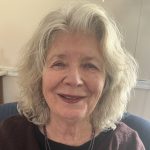
Victress Hitchcock is a filmmaker, poet, writer, meditator, teacher, mother and grandmother. She is a recipient of a Colorado Fellowship of the Arts. Her memoir “A Tree With My Name On It: Finding a Way Home” was published by Bold Story Press in October, 2024. It won the Colorado Authors League 2025 Memoir Award. She lives in Boulder, Colorado. You can read more about her creative work at victresshitchcock.com.
