


There is a lot of poop on Colorado’s highest peak.
A recently published survey of hikers on Mount Elbert in the Sawatch Range above Leadville shows that as many as 11% of hikers on the 14,440-foot mountain poop along the trail and fewer than a third of them use the vault toilets at the trailhead.
“I think it’s very revealing that this trailhead infrastructure at a place like Mount Elbert is absorbing only 30% of the demand,” says Jack Edelson, whose two-year, 283-page dissertation included perspectives from hikers at Grand Teton National Park and a national park in New Zealand. The work earned Edelson a doctorate from Pennsylvania State University for what is likely the world’s most exhaustive study of public land pooping behaviors.

Edelson surveyed 410 hikers on Mount Elbert in the summer of 2024, when the majority of the peak’s 17,000 to 20,000 annual visitors spend as long as eight hours scrambling to the summit. Of the hikers who pooped along the trail, 30% used the free human waste bags — provided by Gunnison County’s PACT Outdoors, and packed those bags back down to the trailhead. And 40% dug holes for their deposits. So for those who are counting, that’s about 880 poops a year on Mount Elbert. If the free bags weren’t there, there could be another 650-ish holes full of feces.
That’s a lot of waste in a delicate alpine landscape ill suited for processing poop.
“We joke but it’s a serious issue because at the alpine there are not bio-organisms in the soil to biodegrade poop,” says Lloyd Athearn, the boss at the Colorado Fourteeners Initiative who, at the start of his mountainous career, helped develop the Clean Mountain Can for hauling human waste up and down Mount Denali in Alaska.
More than 40% of the trailheads at Colorado’s 58 14ers do not have toilets. Edelson’s research at Mount Elbert also noted that as many as one-quarter of high-altitude hikers, especially those who are not adjusted to higher elevations, often endure unexpected gastrointestinal distress.
“So it’s hard for people to complain about poop on the mountain if you don’t have a ready option,” says Athearn, whose vast crew of trail builders and volunteers always carry wag bags — short for waste aggregation and gelling — for packing out poop.
“It is not a lack of willingness”
Jake Thomas was not surprised to see the popularity of his PACT Outdoor waste-hauling packs flying out of the kiosk at Mount Elbert.
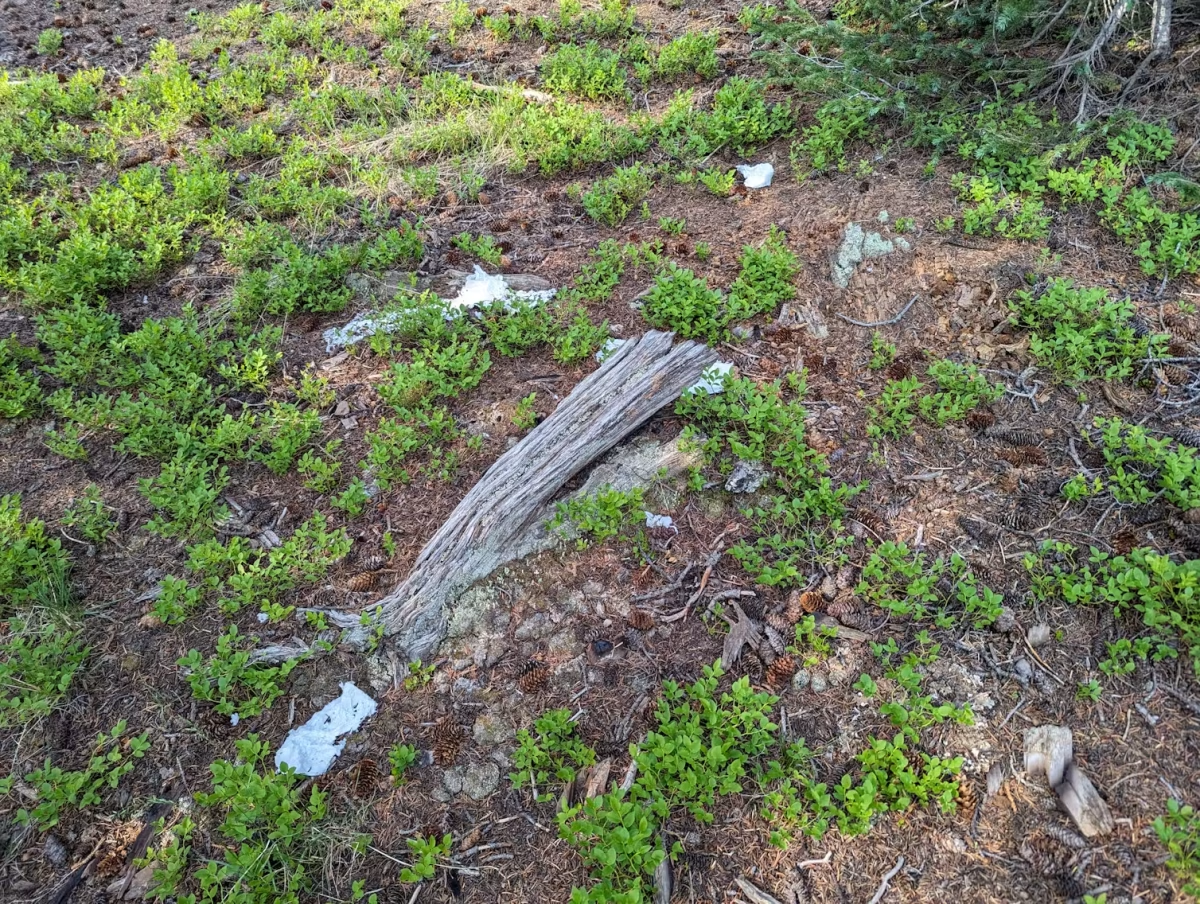
“We pretty much already knew that,” said Thomas, who co-founded the PACT Outdoor backcountry poop kits in 2021 with his brother-in-law Noah Schum.
When the two launched their company, they collected 25,000 emails in a survey of outdoor participants — provided by the Moosejaw Outdoor Business Accelerator at Western Colorado University in Gunnison — and nearly three-quarters of the outdoor respondents said they had to poop in the outdoors without the tools to do it right.
“This is a tools issue. This is a preparedness issue,” says Thomas, whose PACT Kits are sold in nearly 200 REI stores. “It is not a lack of willingness.”
Edelson’s research supports PACT’s understanding. More than 70% of the Mount Elbert hikers Edelson surveyed said they would pay $3 for a wag bag to haul out their waste and nearly 90% said they would be willing to use them on future trips. Thomas and Schum, who partially funded Edelson’s research project at Mount Elbert, used an old recycling bin from the town of Crested Butte to collect their used bags from hikers.
“Look, getting people to carry their own waste is maybe one of the least desirable things ever, right, but 30% of the people used them and 87% said they would use them again,” Thomas says. “People really want to do the right thing. If people pay $3 for a kit, it can be self-sustaining. It’s such a huge shift for the way a lot of us are thinking about how to put an effective stewardship program in place.”
The reliance on wag bags – which include two durable bags and a special powder that dehydrates and kills bacteria – could grow as federal land managers struggle with dwindling budgets and staffing. That means there are not a lot of new vault toilets planned right now as the agencies shrink. And the staffing and funding for consistent maintenance of those facilities are decreasing too.
“In the absence of being able to pay for toilets, what else can we do?” asks Thomas, who has installed PACT Outdoor wag bag kiosks at four locations in the White River National Forest where hikers and backcountry travelers use more than 7,500 a year.
A blended solution with $3 wag bags and $100,000 trailhead toilets
At the Mount Elbert kiosk, one sign asks hikers to take a wag bag, and another directs them to the recycling bin where they can drop it at the end of their hikes. The hikers were generally experienced — the average number of 14ers in the survey takers was 8.8 — and a majority of them said they knew how to use a wag bag. Only one of the people Edelson interviewed brought their own wag bag. And more than 80% disagreed with the statements that they would never carry their own poop.
“This suggests that although visitors are largely unprepared when it comes to bringing bags, they are open to using them if easily available,” the dissertation reads.

The signs were simple and plain so as to not skew the data collected by Edelson. They didn’t want to prod users to take a bag. But imagine if there was more detailed messaging, sharing information about the slow degradation of the alpine environment from poopers and the ease of using a wag bag, Thomas says.
Athearn is wary of kiosks that need consistent stocking and maintenance in remote locations. It can be challenging to make sure the bins where folks toss their used wag bags are emptied regularly. Not only would he like to see every alpine hiker adding waste-removal kits to their backpacks, he wants them to get over the ick factor and haul those bags all the way home.
And of course, toilets at trailheads are key, too.
“It’s not either/or. It’s and,” he says of the toilets and wag bags.
The White River National Forest first offered free wag bags at two trailheads accessing the Maroon Bells-Snowmass Wilderness in 2017. Last year the forest distributed more than 7,500 bags at four trailheads in a partnership with The Forest Conservancy.
With the use of reservations systems at Conundrum Hot Springs west of Aspen in 2018 and more locations in the wilderness in 2023, as well as free wag bags, forest officials are seeing fewer piles of exposed poop in the backcountry around the Maroon Bells. In 2015, rangers in the Maroon Bells-Snowmass Wilderness counted 351 piles that needed to be buried. Last year they found 53.
A new double vault toilet typically costs around $150,000 and a single runs $70,000. Usually those are funded with the Great American Outdoors Act or the Granger Thye Agreement, which allows concessionaires on public lands to invest a portion of their land-use fees into facilities and improvements.
“There is a learning curve”
The White River National Forest has installed three toilets since 2022: a double at the Meadow Lake campground north of New Castle, a single at Sapphire Point Overlook above Dillon Reservoir and a double at Bogan Flats Campground off McClure Pass. The forest is working to secure funding for four toilet facilities at trailheads in the Dillon Ranger District, the most trafficked district in the country.
Vault toilets in campgrounds run by concessionaires are pumped by those private companies. The White River National Forest spends a bit more than $100,000 a year to pump and clean toilets in more remote locations like trailheads.
Backcountry wilderness rangers report that hikers appreciate wag bags at trailheads.
“They find some visitors excited to tell rangers that they used them,” says David Boyd with the White River National Forest. “There is a learning curve but having them readily available may make visitors more likely to give them a try.”
At Rocky Mountain National Park, the Washington-based Toilet Tech company has installed waterless, urine-diverting vault toilets at both the Longs Peak Boulder Field, a wilderness site at the base of one of the most trafficked 14ers in the state. The privies were designed by University of Colorado at Denver students and installed in 2018 to replace solar-powered toilets installed in the early 1980s. The steel-and-rock-walled backcountry bathrooms won lots of accolades, including an American Institute of Architects small projects award in 2019.
In recent years the park began requiring climbers in particularly busy backcountry areas to use wag bags and pack out their poop and toilet paper.