

Letter Fifteen to his sister, Annie
July 16th, 1864 Fort Lyon, Colorado Territory
Dear Annie
I just received a letter from you and was kinder glad to hear from you. I do not write as often as I used to but will answer letters as soon after receipt as I can. I am in Fort Lyon on the Arkansas River. There are five Companies here besides one section of Battery [artillery] and the Regtl Band. I have a good company and get along first rate. Yesterday at Dress parade the Major Comdg Post had orders read to the Battalion complimenting my Company on their military appearance and discipline, referring to them as an example for the troops at this Post. So you see I get along very well. I am the same Boy, Annie, as I used for to be. In fact I imagine that I am only 17 years old. We have been expecting to be ordered into the field for the last month and are still expecting to go on an Indian Campaign. I think I will like it better than laying at this Post for it is as hot as Blazes and the mosquitoes are very numerous and the[y] have got in the habit of biting.
UNDERWRITTEN BY

Each week, The Colorado Sun and Colorado Humanities & Center For The Book feature an excerpt from a Colorado book and an interview with the author. Explore the SunLit archives at coloradosun.com/sunlit.
I got a letter from Mother yesterday and will answer it today if possible. There is a man by the name of Hains here who will start for Bangor in the course of a week. He is acquainted with Stearns Lows folks and is going there. I think I had better send about $200 by him to Mother and if you want any of it perhaps she would give you some. I spend my money most as fast as I make it but when you are in need of some don’t be bashful (for you know we used to be pretty well acquainted with one another) and let me know. I have not heard from Will since he left Lawrence. I am afraid he has been nipped in some of those fights in Tenn. You and Mother write for me to be a Christian and not be wild &c but the Army don’t improve a fellow so much in that respect and you know I never was much of a Christian and am naturally wild, but I have seen so much of the world and are not much changed. I think there is not much danger of me spoiling. Our Col is a Methodist Preacher and whenever he sees my drinking, gambling, stealing or murdering he says he will write to Mother or my sister Annie so I have to go straight.
Give my regards to every body and write when convenient. I would like to get Bill’s wife’s photograph. Haven’t you got one to send me? I have all the family but here and Em in an album. I send you one of mine taken rough without my uniform. Does it look like me? I have my hair shaved so close now that I look like a Penitentiary bird. I have a sure thing that the Indians cannot get my scalp.
Yours &c
Sile
-Anne E. Hemphill Collection

Letter writing as ritual. I just need to mention out loud that letter writing can be a ritual. The commitment to stay connected and the time it takes to write these letters to the family, AND for his mom and sisters to write as often as they do, speaks of family ritual to me. Finding the paper to write on, searching for the pen, sitting down in the fort, sitting outside in the backyard in Lawrence, or Bangor. Maybe having a cup of strong coffee, or tea, or lemonade close by. The only way they can stay connected in the intimate way they all do is through words on a piece of paper. At some point, each of these women, his mom and his sisters, put each of their collections of letters from him, together. They have been passed down now for four generations, and because of Silas’ descendants’ spirit of generosity in sharing these family letters, the book you hold in your hands has been written.
“Witness at Sand Creek”
>> READ AN INTERVIEW WITH THE AUTHOR
Where to find it:
- Prospector: Search the combined catalogs of 23 Colorado libraries
- Libby: E-books and audio books
- NewPages Guide: List of Colorado independent bookstores
- Bookshop.org: Searchable database of bookstores nationwide

SunLit present new excerpts from some of the best Colorado authors that not only spin engaging narratives but also illuminate who we are as a community. Read more.
Every time I read this letter out loud at Silas’ grave, Pastor Dustin Adkins says, “He’s more of a Christian than anyone I know.” And every time, I smile. A Disciples of Christ pastor for 30 years, he knows a thing or two about who professes to be a Christian, and is, or isn’t.
We met up recently in his Denver church office, where the fake fire in the fireplace blazed and we drank coffee. Fairly new to this United Church of Christ church, he is aware that the faith community where he serves is a parish where hospitality runs deep, and the commitment to feeding hungry people is part of this church’s origin story.
From childhood, Adkins, a white, gay man, made intimate connections with stories that family members told, and especially with his grandfather, who was a great storyteller. Though he hasn’t heard those childhood stories from his grandfather in more than 35 years, “I carry an emotional portrait of this man and awareness of how he influenced my life. Historically, we don’t get this three-dimensional wallflower of history, but then there are those people who are truly exceptional through their stories. I think Silas is one of those for me.”
He says curiosity drew him to his first visit to Silas’ grave to hear me read the letters out loud on his July birthday for the first time. “I had curiosity about this new, random friend and a curiosity talking about the stories of this soldier. It was such an oddball thing; I had to go. I wasn’t expecting to fall in love with the idea of Silas.”
There is something real about him, he added. In these letters, there is nothing fake or presumptive. He described Silas as a brilliant writer. “His writing and experiences have a warmth we can relate to and a beauty in his connection with others.” It’s in the place of community, his family, friends, and colleagues, that Adkins sees Silas as a natural leader.
The line “that I never was much of a Christian” doesn’t remind him of a traditional religiosity, “He’s certainly not pious.” But Adkins does see a man of faith. “People say to me sometimes, you’re a pastor, preaching, and saying and doing the Lord’s work, and they think of that as the way. Religion has brainwashed us into thinking that is Christianity. But that’s not what Christianity is about. In every expression of his being I hear his commitment to justice, which is exceptional. There are people who are justice, everything exudes justice. And with everything they are and everything they do, they live out a call to love your neighbor and stand up with the oppressed.
“What could be more Christian than putting your life on the line for the benefit of others?”
Knowing Silas through these letters, Adkins feels that it’s Silas’ family, friends, and community, beginning in his childhood, that is the great teacher of his faith. “Their commitment to justice and dismantling enslavement goes well beyond thoughts, it’s a faith predicated by action.
“Anytime we encounter these letters, I experience a deep grief about knowing what’s coming. Not just the Massacre, but what’s coming for Silas. We all know people that know the right thing, and Silas is one of those… his is the product of our raising, our faith.”
Adkins reminded me that Silas’ line about the “Methodist Preacher” who is pious about stealing and murdering appears to reference Chivington, who does those very things four months after this letter is written. Still, in this July letter there is a sign of respect.
Because he knows these letters so well, Adkins has struggled with the idea that only two soldiers out of the 600 that day of the Massacre disobeyed orders and wonders out loud if there had to be more men who felt like Joe (Lt. Joseph Cramer) and Silas, “but we fall prey to following the crowd, compromising our moral compass, decisions, and values, even if we’d like to think we couldn’t.
“I think how lonely it must have been… to feel so clearly to be morally right and be left alone.” When I asked him if there were others in history that he felt were like that… clearly understanding what is right, doing right, and then being alone… he quickly said “Dietrich Bonhoeffer.”
When pressed about how these two men who lived in different centuries, countries and faiths are alike, Adkins replied that it’s the parallel of their immense moral courage, and added that their decisions were not made in an absence of fear, but instead that these two men had to know the risks of speaking out about the events they saw happening. “There are people in the world who are firemen, people who walk into a fire, and everyone else is running out. Silas and Dietrich go into the fire knowing things have to be said.”
Bonhoeffer was a German Lutheran pastor and theologian who was a vocal part of the anti-Nazi resistance. He was arrested in April 1943, transferred to Flossenburg concentration camp, and was executed by hanging on April 9, 1945, with liberation only days away. He was 39 years old. Of all his writings, The Cost of Discipleship is the most well-known and is considered a modern-day classic for Christian theologians on what it means to follow Christ, especially in a world where a dangerous and criminal government leads.
“So often we turn our eyes from injustice because it’s painful or we don’t know what to do with it. I ask, how do we bring about justice through violence?” says Adkins.
“Imagine how hard it was for him that he couldn’t stop the Sand Creek Massacre.”
With days left before one of the busiest times of the liturgical year for a pastor, we said our goodbyes. As we walked to the church parking lot, I remembered Adkins told me a few weeks earlier that he would bring pie to next year’s letter reading at Silas’ grave in July. The idea of eating pie in community in the cemetery with others who love Silas as much as I do, filled my heart with gladness and peace. In a broken world that needs so much more gladness and peace, my prayer is that we eat more pie at the grave together.
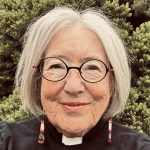
Rev. Dr. Nancy Niero, a United Church of Christ clergywoman who has served a 15-year ministry as a hospice chaplain, is the author of “Witness at Sand Creek, The Life and Letters of Silas Soule.” She is a graduate of Iliff School of Theology with a Master of Divinity degree, and received her Doctor of Ministry in 2023 from Phillips Theological Seminary. Her newest writing project is “Good Trouble: Racial Justice Coaching for Clergy in the 21st century.”
