


With the peak of election season fast approaching, the Colorado GOP is in dire financial straits and remains mired by infighting, which last week resulted in the resignation of the party’s vice chair for the second time in less than a year.
The party reported raising $125,000 and spending about $133,000 last quarter through its federal campaign account, starting the year off with about $76,000 in the bank. But it also had $166,823 in outstanding debts, mostly unpaid legal fees. Those stem from the party’s successful efforts to defend itself in a lawsuit against Chairwoman Brita Horn that has been kept alive by a group of Republicans loyal to former party Chairman Dave Williams.
Things got so bad last quarter that the party had to take out a bank loan to address cash flow issues.
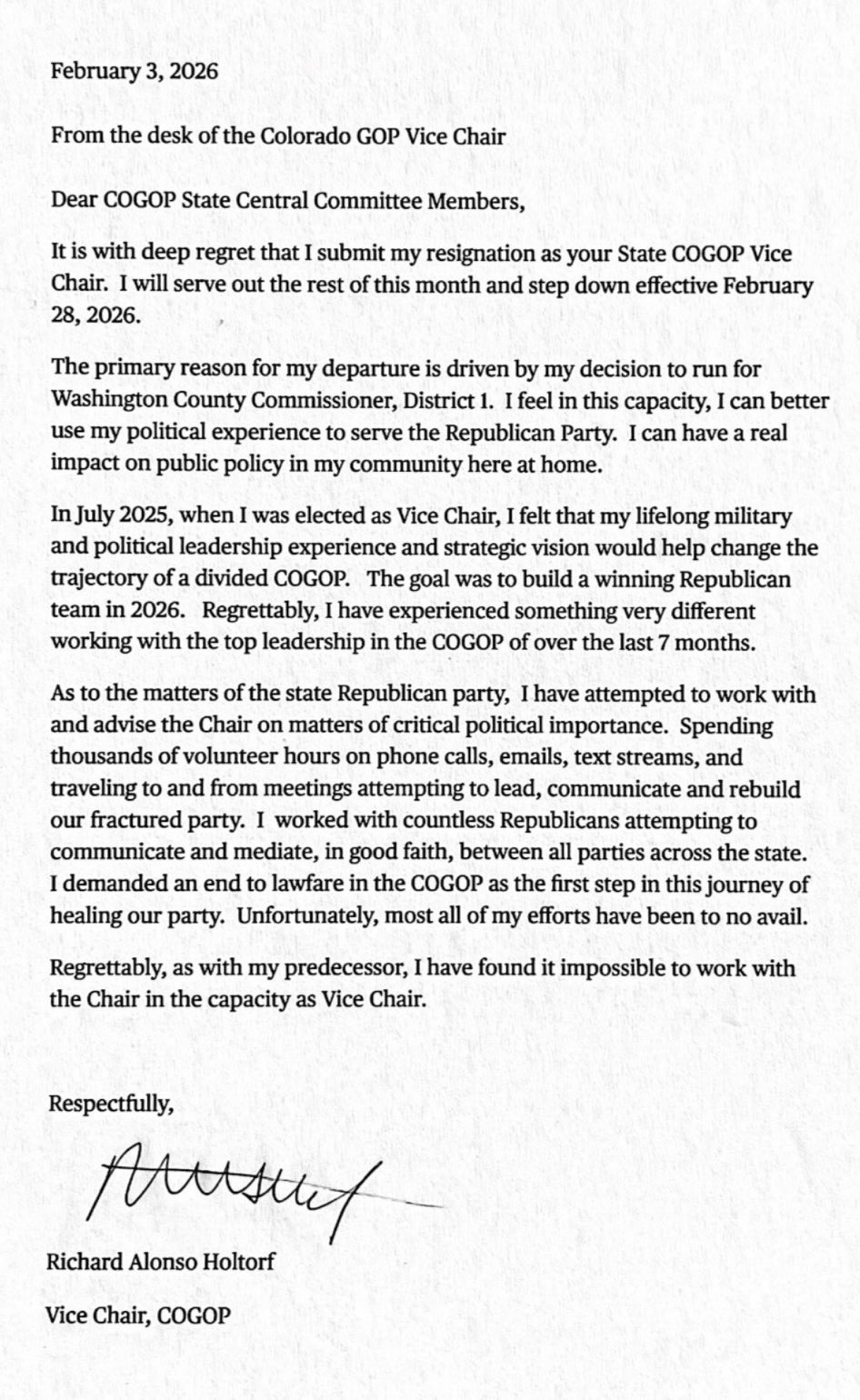
The funding situation was revealed in the Colorado GOP’s Jan. 31 filing with the Federal Election Commission. Days later, former state Rep. Richard Holtorf announced that he was stepping down as vice chair of the party, citing conflicts with Horn.
In his resignation letter, Holtorf said he has “found it impossible to work with the chair.”
Colorado Republicans have been trying to find their way back into power since 2018, when their foothold in state government crumbled. Things only got worse in subsequent election cycles.
The dual financial and leadership crises now facing the party are threatening to keep Republicans stuck in their cycle of political misfortune — or, even worse, cost them what little power they have left.

In an interview with The Colorado Sun, Horn — who is facing increasing frustration from Republican candidates and party activists — conceded that ongoing headlines about the party’s infighting have made raising money difficult. She understand why donors wouldn’t want to open their wallets.
“We have to earn everybody’s trust back after all of this,” she said.
But she also called on Republicans to move past the pettiness.
“Anything other than electing Republicans, growing the party and fundraising relentlessly — this is all a distraction,” she said. “We have work to do.”
The finances
The Colorado GOP has been on shaky financial ground since 2023, when fundraising dried up under Williams. Horn hasn’t been able to reverse the trend since she took over in March 2025.
In October, the party drew from a $25,000 line of credit it has with Timberline Bank at a 7.25% annual percentage rate.
“We’ve never tapped the full amount,” said Alec Hanna, executive director of the party. “It’s helped us with cash flow issues to pay our bills on time.”
As of the start of last week, the party was using about $8,000 from that line of credit and had about $20,000 in the bank, Hanna said, explaining that the Colorado GOP has paid off debt from the line of credit as it is able.
Hanna is the only employee on the party’s payroll, and his salary appeared to be the biggest expense for the party last quarter.
The Colorado GOP is still fighting in court to recover the nearly $150,000 in attorneys’ fees it has incurred to defend itself and Horn, mostly in the lawsuit that Williams’ allies tried to reignite. The case was originally brought last year by the party, when it was led by Williams, against Horn and a group of other Republicans who sought to depose him ahead of the 2024 election.

Horn, when she became chairwoman, sought to have the case dismissed. She was successful, but not before Williams’ supporters tried to intervene and keep it going. In the process, the Colorado GOP incurred a hefty legal bill.
There are also other court matters running up the party’s legal costs. It’s unclear how long it will take to resolve those disputes.
“I think we’re getting closer and closer,” said Horn.
State parties are increasingly unimportant when it comes to campaign cash spent on things like advertising. Most of that money is now routed through political action committees and dark money nonprofits.
But the parties need funding to carry out their central purpose: organizing. Without a working state party, campaigns up and down the ballot can struggle to work together. That’s what happened in 2024 under Williams’ leadership, when campaigns opted to coordinate around the party and its financial problems rather than through it.
“The party is the only group in the state that can help after the primaries from the governor all the way down to dog catcher,” Horn said. “We can do the work for all the candidates, instead of all the candidates having to get their own people knocking doors.”
Horn said she’s confident the money will come in. She’s expecting infusions from national Republican groups, too.
“We’re gonna have the resources,” she said, “it’s just gonna take us a little bit more time to get it.”
The Colorado Democratic Party is not having the same financial problems. It reported raising $86,000 into its federal campaign account in December, while spending $111,000 and ending the year with nearly $180,000 in the bank and no debts. It has used that solid financial footing to hire staff in preparation for the election.
Holtorf’s departure
Holtorf is the second vice chair to resign citing conflicts with Horn.
Darrel Phelan left the position over the summer, saying he had “been systematically sidelined and deliberately ignored by our chair.” Holtorf was elected to replace him.
Holtorf said his decision was also motivated by his bid to become a Washington County commissioner. But he made it clear in an interview with The Sun that he doesn’t have anything good to say about Horn as he heads for the exit.
“She doesn’t listen to good, sound advice. She doesn’t pursue and make good, sound decisions. She’s vindictive and divisive,” Holtorf said in an interview with The Unaffiliated. “She relies way too much on lawyers’ advice and legalese and legal action.”
Holtorf said he encouraged Horn to drop her pursuit of attorneys’ fees in the lawsuit that Williams’ allies attempted to continue and tried to organize a sit-down with her detractors to reach a solution outside of the courtroom. He said the legal debts are one of the reasons the party is struggling to fundraise, because donors don’t want their money going to cover that tab.
“The lawyers need to get the hell out of the way,” Holtorf said.

He said the party can’t move past its divisions under her leadership.
“The real Brita Horn is not the same person that presented herself at the state assembly last March when we elected our officers,” Holtorf said.
The party’s No. 3 leader, Secretary Russ Andrews, told Colorado Politics he is also eyeing an exit later in the year.
“Brita is very difficult to work with,” Andrews told the news outlet last week, adding that he hasn’t spoken with Horn in “over a month.”
Horn said Holtorf’s offer to broker a deal with the Williams faction of the party didn’t come until after the legal cases had been decided in the Colorado GOP’s favor.
“They all came crying to him because they realized there were consequences for filing a frivolous lawsuit,” she said. “I can’t undo it. It’s called law. We have to finish that, and we’re waiting for a decision on the fees.”
Horn also denied that she was being vindictive.
“It isn’t personal,” she said. “This isn’t about personal vendettas. It’s about accountability and the ability to execute our mission.”
Holtorf’s last day as vice chair will be Feb. 28. The party must hold a special central committee meeting to elect his replacement. It’s likely to devolve into a public airing of grievances.
A new vice chair must be selected, per the party’s bylaws, within 40 days of when Holtorf’s resignation takes effect.